Category: News

  • Fidelity Bank Distributes Food Packs To 1,500 Mokwa Residents Affected By Flood

    Fidelity Bank Distributes Food Packs To 1,500 Mokwa Residents Affected By Flood

    In a swift response to the recent flood that tragically displaced many families in Mokwa, Niger State, Fidelity Bank Plc has donated food packs to over 1,500 affected residents through its Food Bank Initiative.

    The Fidelity Food Bank Initiative is a humanitarian outreach designed to help vulnerable communities across Nigeria. Through partnerships and collaboration with its branches and stakeholders, the bank delivers food packs to those in need, helping to ease hunger and provide hope during difficult times.

    Commenting on the donation, the Divisional Head, Brand and Communications at Fidelity Bank, Dr. Meksley Nwagboh, said: “At Fidelity Bank, we believe corporate citizenship means standing by communities in their greatest time of need. We are honored to support the people of Mokwa through the Fidelity Food Bank Initiative. This is more than just a relief effort — it’s a affirmation of our promise to always be there for the people and communities we serve, especially in challenging moments.”

    He added: “This donation reflects our collective responsibility to respond with compassion and urgency. The people of Mokwa are not alone — we share in their struggles, and we will continue to support them as they rebuild their lives.”

    The distribution event was well attended by government officials from Niger State, led by the First Lady, Hajiya Fatima Umaru Bago. Also present were the Secretary to the State Government, Alhaji Abubakar Usman Gawu; Chief of Staff to the Governor, Alhaji Usman Abdullahi Gbatamangi; and the Deputy Chief of Staff, Alhaji Yusuf Sadiq. Other members of the delegation included the Commissioner for Budget & Planning, Alhaji Mustapha Ndajiwo; Commissioner for Education, Hajiya Hannatu Jibril; and the Commissioner for Humanitarian Affairs, represented by the Permanent Secretary, Hajiya Barrister Mairo Mamman Mann.

    The Commissioner of Information, Hajiya Binta Mamman, and Alhaji Ayuba Usman Katako, representing the Association of Local Governments of Nigeria (ALGON) in Niger State, alongside various Local Government Chairmen, were also present to show their solidarity with Mokwa and its people.

    The Fidelity Food Bank donation in Mokwa follows similar initiatives in areas affected by disasters. The bank previously donated food and sanitary items to victims of a fire outbreak in Taraba State and provided cash and food to those affected by the Zaria Central Mosque collapse in 2023.

    Ranked among the best banks in Nigeria, Fidelity Bank Plc is a full-fledged Commercial Deposit Money Bank serving over 9.1 million customers through digital banking channels, its 255 business offices in Nigeria and United Kingdom subsidiary, FidBank UK Limited.

    The Bank is the recipient of multiple local and international Awards, including the 2024 Excellence in Digital Transformation & MSME Banking Award by BusinessDay Banks and Financial Institutions (BAFI) Awards; the 2024 Most Innovative Mobile Banking Application award for its Fidelity Mobile App by Global Business Outlook, and the 2024 Most Innovative Investment Banking Service Provider award by Global Brands Magazine. Additionally, the Bank was recognized as the Best Bank for SMEs in Nigeria by the Euromoney Awards for Excellence and as the Export Financing Bank of the Year by the BusinessDay Banks and Financial Institutions (BAFI) Awards.

  • Fidelity Bank Funds Construction of Nigeria’s First Privately Built Onshore Oil Export Facility In 50 Years

    Fidelity Bank Funds Construction of Nigeria’s First Privately Built Onshore Oil Export Facility In 50 Years

    In a significant boost to Nigeria’s crude oil production and export capabilities, leading financial institution Fidelity Bank Plc has facilitated the construction of the country’s first privately built and operated onshore crude export terminal in over 50 years.

    The terminal, located at the Otakikpo Marginal Field in Rivers State and operated by Green Energy International Limited (GEIL), successfully exported its first crude oil cargo at 2pm on Sunday, June 8, 2025, when a Shell-chartered vessel lifted the maiden shipment — marking a key milestone in the nation’s oil and gas industry.

    Commenting on Fidelity Bank’s role in making the project a reality, Managing Director/CEO Dr. Nneka Onyeali-Ikpe said: “Our partnership with Green Energy International underscores our confidence in the ability of indigenous companies to drive progress in the country’s energy sector.

    “With an initial storage capacity of 750,000 barrels — expandable to 3 million — and a loading capacity of 360,000 barrels per day, this terminal will significantly boost Nigeria’s energy security. Transformative projects like this reflect Fidelity Bank’s deep-rooted mission to help individuals to grow, businesses to thrive and economies to prosper.”

    The launch of the terminal is expected to ease reliance on offshore facilities and attract fresh investment into the country’s oil industry.

    GEIL’s chairman, Prof. Anthony Adegbulugbe, described the feat as a historic milestone made possible by divine intervention, the hard work of the company’s team, and the support of regulators.

    “We appreciate all our partners and the dedication of our indigenous technical team who made this happen. It’s a proud moment for us, for Africa’s energy industry, and for the future of the country’s oil and gas development.”

    According to Prof. Adegbulugbe, the terminal was constructed in under two years and stands as the first crude terminal developed by a private operator on the continent.

    The terminal is designed to handle up to 250,000 barrels per day of crude injection, while the Otakikpo field currently produces about 10,000 barrels per day. The company explained that the terminal also provides a strategic evacuation route for more than 40 nearby stranded fields — collectively holding an estimated 3 billion barrels of oil equivalent — thereby strengthening production and export capabilities.

    With growing global demand for Africa’s crude oil, the Otakikpo terminal is poised to attract further investment and reinforce Nigeria’s role in the international energy market. The facility will be key to improving oil evacuation and boosting production in line with the country’s long-term energy goals.

    Ranked among the best banks in Nigeria, Fidelity Bank Plc is a full-fledged Commercial Deposit Money Bank serving over 9.1 million customers through digital banking channels, its 255 business offices in Nigeria and United Kingdom subsidiary, FidBank UK Limited.

    The Bank is the recipient of multiple local and international Awards, including the 2024 Excellence in Digital Transformation & MSME Banking Award by BusinessDay Banks and Financial Institutions (BAFI) Awards; the 2024 Most Innovative Mobile Banking Application award for its Fidelity Mobile App by Global Business Outlook, and the 2024 Most Innovative Investment Banking Service Provider award by Global Brands Magazine. Additionally, the Bank was recognized as the Best Bank for SMEs in Nigeria by the Euromoney Awards for Excellence and as the Export Financing Bank of the Year by the BusinessDay Banks and Financial Institutions (BAFI) Awards.

  • How N5bn Bond Bail Signed By Fidelity Boss Was Confused As Bribe

    How N5bn Bond Bail Signed By Fidelity Boss Was Confused As Bribe

    Fidelity Bank has dismissed reports alleging that its Managing Director (MD) paid N5 billion in bribes to avoid detention by the police.

    In a statement released on Monday, the bank explained that the MD was asked to sign a N5 billion bail bond as part of a police investigation into a matter involving the account of a customer, Woobs Resources Limited.

    The bank described the reports — particularly a story by Sahara Reporters — as false and mischievous, meant to mislead the public into believing a bribe was paid.

    “The police invited the MD during their investigation into a complaint made by James Onyemenam against Mr. Ogo Whoba over the management of Woobs Resources’ account. After taking her statement, the police asked the MD to sign a N5 billion bail bond on her own recognizance.

    “It is this bond — not a bribe — that was referenced in a phone conversation with Mr. Ogo Whoba, which was secretly and unlawfully recorded. At no time did the MD pay N5 billion to the Police to avoid detention; signing the bond was simply a standard part of her release conditions.”

    The bank also explained that the same false claim had previously been raised in a petition to the Inspector General of Police by Victor Ukutt on behalf of Mr. Whoba. The Inspector General investigated the matter thoroughly and dismissed it as baseless.

  • Clarification of N5Billion Bail Bond Signed by Fidelity Bank MD

    Clarification of N5Billion Bail Bond Signed by Fidelity Bank MD

    Our attention has been drawn to a publication on Sahara Reporters website titled, “Fidelity Bank MD Onyeali-Ikpe Confesses to Paying ₦5Billion To Avoid Police Detention Amid Over ₦19Billion Fraud Probe”.

    We would like to categorically state this story is patently false and has been maliciously written to deceive the public into believing that a N5billion bail bond was payment to the Police to avoid detention.

    While we are unable to comment on the substantive matter as it is before a competent court, we wish to state emphatically that there is no truth in the claims of the story.

    The police invited the MD during their investigation of a matter reported by James Onyemenam against Mr. Ogo Whoba in respect of the management of the accounts of Woobs Resources Limited. After taking her statement, the police requested the MD to sign a N5 billion bail bond, which she signed on self-recognizance.

    It is the N5billion bail bond that was signed by the MD that was referenced in her conversation with Mr. Ogo Whoba which was recorded without her consent. At no time did the MD pay N5bn to the Police to avoid detention but rather signed a bond as part of her bail requirements.

    This mischievous allegation was presented to the Inspector General of Police (IGP) in a petition written by Victor Ukutt for himself and on behalf of Mr. Whoba. The IGP commissioned a detailed and independent investigation into the allegation and found same to be baseless.

    As a leading financial institution with a long-standing commitment to strong corporate governance, we remain dedicated to adhering to the rule of law and maintaining the highest ethical standards in all our dealings.

  • Fidelity Bank ED, Kevin Ugwuoke takes over as President of Risk Managers Association

    Fidelity Bank ED, Kevin Ugwuoke takes over as President of Risk Managers Association

    Kevin Ugwuoke, Executive Director and Chief Risk Officer of Fidelity Bank Plc, has formally assumed office as President of the Chartered Risk Management Institute of Nigeria (CRMI). His leadership promises a reform-focused era anchored on policy advocacy, ethical standards, and digital innovation to deepen risk governance across sectors in the country.

    Speaking during the presidential handover ceremony in Lagos over the weekend, Ugwuoke — who also doubles as acting President of the Federation of African Risk Management Associations (FARMA) — described his election as “a call to action.” He pledged to reposition CRMI as a thought leader and institutional partner in shaping the future of risk management in Nigeria’s national development.

    “Our mission is more than just certification; it’s about strengthening the culture of risk governance across sectors. We will collaborate with regulators, raise awareness, and provide practical tools to help organizations embed risk discipline at all levels.”

    Ugwuoke outlined a five-pronged strategy to guide his administration: strengthening professional education and certification; deepening policy and regulatory engagement; accelerating digital transformation; integrating ESG and climate risk into corporate strategies; and mentoring the next generation of risk practitioners.

    He explained that CRMI will align its initiatives with key policy institutions — including the Nigerian Economic Summit Group, the National Assembly, and sub-national governments — to help embed robust risk frameworks into economic development plans.

    “We must integrate risk thinking into how we plan, govern, and invest. We will advocate for more inclusive regulations to empower small and medium enterprises, improve macroeconomic stability, and foster institutional resilience.”

    Ugwuoke also announced plans to revise the Institute’s curriculum, introduce specialized certifications to reflect emerging risks, and implement a new National Risk Observatory to provide real-time risk data to both the public and private sectors.
    “Digital innovation will be central to how CRMI operates going forward. We are automating our backend, delivering more virtual training, and employing technology to scale our impact across the country and beyond.”

    In his remarks, the outgoing President of CRMI, Ezekiel Oseni, challenged the new leadership to consolidate on the achievements made under his tenure — from securing chartered status and strengthening partnerships to gaining greater international recognition — and take the Institute to the next level.

    Also speaking on the occasion, Chukwuma Nweke, deputy managing director of United Bank for Africa (UBA), delivering a goodwill message on behalf of Group Managing Director, Oliver Alawuba, described Ugwuoke as a worthy successor. “As Professor Oseni hands over the baton to Kevin Ugwuoke — a well-respected leader in the risk management ecosystem — we are assured CRMI is poised for greater achievements under his watch.”

    Nweke stressed that growing economic uncertainties — from inflation and exchange rate volatility to growing debt — underscore the need for a more strategic view of risk. “Risk must be recognized not as a compliance obligation or a cost center but as a key enabler of resiliency and growth. Institutions that embed risk into their strategies will absorb shocks more effectively, unlock value, and inspire investor confidence.”

    As part of the day’s ceremonies, 11 distinguished practitioners were conferred with the Fellow of Chartered Risk Manager (FCRMI) award, while 21 new members were formally inducted as Chartered Risk Managers (CRM). Furthermore, a new Governing Council was inaugurated to oversee the affairs of the Institute for the 2025–2027 term, marking a decisive step forward in institutional renewal and policy direction.

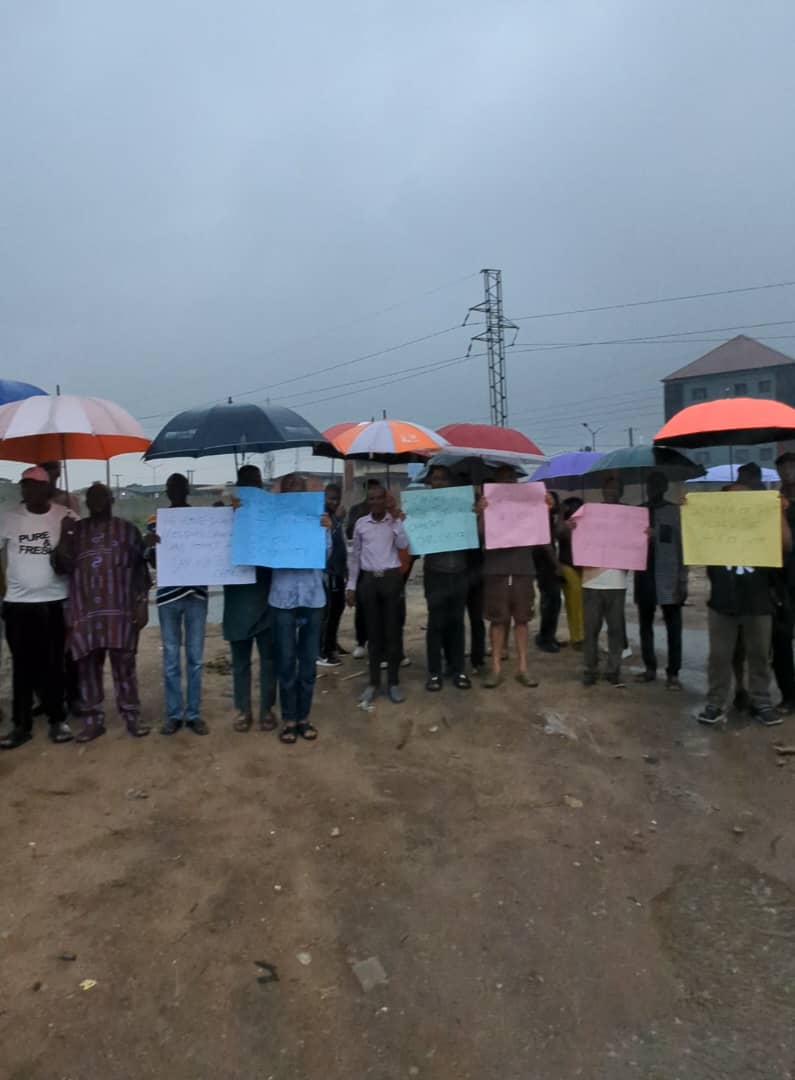
  • Residents Protest Construction Of Cemetery

    Residents Protest Construction Of Cemetery

    …Developer declines comment

    Residents of Natufe estate and environs in Lagos on Saturday morning defied the heavy rains to protest the alleged construction of a cemetery within their community.

    Natufe is located off Babs Animashaun Road in the Bode Thomas area of Surulere, mainland Lagos.

    They took their protest to the construction site, a large expanse bordered by residential buildings, a school, a church and just a few meters away from the Traffic Light at Bode Thomas junction.

    Chanting “no cemetery” and other slogans to register their displeasure, the protesters waved placards emphasising their disapproval of the proposed burial ground in the neighbourhood.

    Speaking to journalists, the Chairperson, Natufe/Animashaun Community Development Association (CDA), Alhaja Omolabake Aminat Braimoh, said they were out to protest the construction of a cemetery in the neighbourhood.

    “This man tried it over two years ago and we opposed it. Suddenly, we noticed he has started construction again and he is working day and night to achieve his purpose. So, we are out here again saying no because cemetery is not good here.

    “We heard he wants to build an adult cemetery here and one for children about three blocks away. We do not want it. Look around you, this is a residential neighbourhood. We have children and elderly people here. We have schools, churches and estates here too. “Locating a cemetery will pollute our land. We are not using pipe-borne water. Our source of water is borehole which cemetery will pollute.”

    Asked what steps have been taken by the CDA aside from the protest, she said letters had been written and sent to the Chairman, Coker-Aguda LCDA, adding that more letters would be sent to relevant agencies of government to stop the developer.

    “We do not want to take laws into our hands and that is why we are following the due process.
    “In the letter, we detailed our displeasure about the illegal construction of cemetery and reminded the chairman that we had objected same in the past.

    “They commenced work here during the EID holiday and have completely disregarded the community’s disapproval. We urged the chairman to wade into the issue and order the developer to immediate stop work on the site until the intention and purpose of the construction is established,” she added.

    Also speaking, a former CDA chairman, Olarenwaju Olaniyan, confirmed that the developer, Olumide Amure tried the same thing during his tenure and was fought to a standstill.

    “Olumide Amure knows me very well. The first time he started this, some years ago, we fought it from the local government to the state level. We have all the documents with us. He was stopped by the government.

    “But I heard now that he has permission. I am not speaking about that permission because I trust that Governor Babajide Sanwo-Olu will never give such a permission. The developer should know the consequences of his actions and desist from such a wicked act.

    “We will not allow him to pollute our land. We won’t allow him to kill us all because what he is trying to do is bring an epidemic for those of us living here.

    “We do not have good water here. We are surviving on boreholes and the moment you start burying people here, you will pollute our ground and water. You will kill us all. We won’t allow that.

    “We have stayed here for over 50 years. We have people who are 80 years and above among us. When do you want to kill us? Did we offend you? Mr. Olumide Amure, we do not want to fight you, we are appealing to you to do a business that will develop the community and not one that will destroy us. The community says no to turning this place to burial ground.

    “You do not even live in this neighbourhood. You bought this land less than three years ago and all you can think of is to put a cemetery here?” Olaniyan queried.

    According to him, 11 petitions were sent to relevant agencies and offices the first time he came up with his cemetery plans, adding that the community would do the same this time around.

    The Councilor representing Natufe/Animashaun Ward at the Local Government said they were not aware of any approval to the developer to site a cemetery there. He said he received a complaint from the CDA that the developer was building a burial ground in a residential area.

    “A cemetery is not suitable in such a place. They have complained that they don’t want it and as their representative at the local government, I will take their complaint forward to the relevant authorities,” he said.

    Contacted for reaction on Saturday, the developer told our reporter that he would revert, pleading for time to provide a detailed response.

    He asked when the reporter intended to go to press and was told his reaction was needed and that the story would stand down till Sunday afternoon to await his comments.

    However, at the time of filing this report (3pm) on Sunday, Mr. Amure was yet to send his response and a reminder message to his phone number was not replied to.

  • Governor Manasseh Mutfwang Marks Two Years With Bold Reforms, Revives Plateau’s Hope, Infrastructure

    Governor Manasseh Mutfwang Marks Two Years With Bold Reforms, Revives Plateau’s Hope, Infrastructure

    As he clocks two years in office, Plateau State Governor Caleb Manasseh Mutfwang has reaffirmed his administration’s commitment to transformation and inclusive governance, highlighting sweeping reforms and developmental strides across transport, healthcare, education, agriculture, and infrastructure.

    In a statewide broadcast on May 29, 2025, Governor Mutfwang described his journey since May 29, 2023, as one marked by “bold steps, unshaken resolve, and a vision of restoration.” He was joined in the reflection by Deputy Governor Ngo Josephine Piyo, emphasizing gratitude and determination to further advance the state’s development agenda.

    The administration’s proactive approach to security has included the revitalization of Operation Rainbow, the establishment of an Emergency Communications Centre with a toll-free line, and the creation of a tech-driven Plateau State Activity Centre for surveillance.

    On public service reforms, Mutfwang noted the clearance of salary arrears, resumption of gratuity and pension payments (last done since 1984), restoration of promotions, training, and reconnecting of government offices to the national grid — all aimed at restoring dignity to Plateau’s civil workforce.

    A key highlight was the expansion of the Tin City Metro transport service, now operating 30 brand-new buses and benefitting over 9,000 commuters daily. With smart travel cards and modern infrastructure, the system is seen as a model for urban transit. The governor also referenced partnerships with ValueJet Airlines and the Nigerian Railway Corporation to improve intercity air and rail travel.

    In agriculture, Mutfwang said over 900 hectares of land have been recovered for IDPs, ₦16 billion worth of inputs distributed, and 20 tractors procured under the ACReSAL project. Plans are underway for agro-processing hubs and the transformation of PADP into Plateau Agri-Business Development Agency (PABDA). A Ministry of Livestock Development was also established to foster peaceful coexistence between farmers and herders, beginning with a pilot in Wase.

    The administration reports over 111 km of urban roads rehabilitated and more than 3,000 km of previously abandoned roads now under construction. An additional 380 km of rural access roads and 66.4 km of urban projects are being executed by various ministries. The NG-Cares initiative is also driving near-completion of 26.7 km of community roads.

    In health, Plateau Specialist Hospital was transformed with equipment worth ₦2 billion and recruitment of consultants. Health insurance enrolment rose from 93,605 in 2023 to 208,550 in 2025. Over 9,000 vulnerable residents are now covered.

    In education, the government slashed tuition by 50 percent for indigenes, tripled scholarship funding, upgraded Plateau State University and the College of Education, Gindiri, and increased Plateau Polytechnic’s enrollment from 3,000 to 8,000. A total of 148 classroom blocks and boreholes were delivered across the 17 LGAs.

    Contracts worth ₦30 billion were awarded for Langtang North Water Project, while several isolated schemes and solar-powered boreholes are ongoing. The state’s environmental revitalization includes reviving monthly sanitation, raising stipends for street sweepers, and tackling open defecation.

    Tourism and hospitality have also been targeted, with the Jos Wildlife Park and Plateau hotels undergoing revival, and cultural festivals being actively supported.

    Governor Mutfwang pointed to legal reforms promoting mediation and access to justice, a commitment to inclusive appointments across religious and ethnic lines, and LGAs now empowered to execute grassroots projects.

    Looking ahead, the governor announced priorities such as the rebuilding of the burnt Jos Main Market, a new state-of-the-art market at Maraban Jama’a, and the construction of agro-logistics centres and a modern abattoir.

    He concluded with a call to unity and optimism: “We may not have reached the mountaintop yet, but we are no longer in the valley… Plateau is rising again — and by the grace of God, we shall all rise with it.”

  • Plateau State Governor Highlights Major Achievements As He Marks Two Years of Transformation

    Plateau State Governor Highlights Major Achievements As He Marks Two Years of Transformation

    Governor Caleb Manasseh Mutfwang has rolled out a comprehensive performance scorecard to mark his administration’s two years in office, spotlighting extensive reforms and life-changing projects across key sectors including infrastructure, transport, agriculture, education, healthcare, and security in Plateau State.

    Elected in 2023 under the People’s Democratic Party (PDP), Mutfwang came into office amid economic hardship, insecurity, and a disillusioned civil service. Despite post-election legal battles, the governor quickly got to work, executing a people-centered development agenda that earned him national recognition, including The Sun Newspaper’s Governor of the Year 2024 award.

    In a detailed account of his administration’s progress, Mutfwang said his government had successfully addressed critical challenges inherited from previous administrations, including a N400 billion debt burden, five months of unpaid salaries, and deteriorated infrastructure.

    On security, the state government revived Operation Rainbow, retrained over 600 operatives, and launched a toll-free emergency line to respond swiftly to threats. A new Plateau Special Activities Centre, equipped with surveillance technology, was established to monitor security across the 17 local government areas. Governor Mutfwang also engaged federal security agencies and redeployed security forces to volatile areas like Mangu, Bokkos, Barkin Ladi, and Bassa.

    Efforts to support Internally Displaced Persons (IDPs) were also scaled up, including visits to camps, relief interventions in partnership with NEMA, and the formation of a resettlement committee whose report is now being implemented.

    On workers’ welfare, the administration has consistently paid salaries and pensions since assuming office. It also cleared decades-old gratuities and pension arrears, increased pensions by 100 percent, and approved hazard allowances for healthcare workers. Overdue staff promotions have been implemented to boost civil service morale.

    In the transport sector, the state introduced the Tin City Metro service, now operating 30 high-capacity buses that transport over 9,000 commuters daily. The service has reduced transportation costs, created jobs, and expanded to new routes. The state also refurbished 15 long-distance buses, acquired 20 Toyota Sienna vehicles for the Jos–Abuja corridor, and improved air connectivity through a partnership with ValueJet Airlines. Rail service from Jos to Kuru has also been revived in collaboration with the Nigerian Railway Corporation.

    In agriculture, the administration reclaimed over 900 hectares of land for displaced farmers, distributed ₦16 billion worth of inputs, and launched livestock and agro-processing initiatives. Collaborations with international partners, including IITA and the African Development Bank, have enhanced the state’s capacity for sustainable food production. Mechanized farming is being promoted through the procurement of 20 tractors and plans for agricultural processing zones.

    On infrastructure, the government completed or began construction on more than 3,000 kilometers of roads across urban and rural areas. Projects abandoned since 2013 were revived, while others were initiated under various ministries and donor-backed programs like RAAMP and NG-CARES. Major bridges, flyovers, and intercity roads are also underway.

    Healthcare has seen a substantial upgrade with the transformation of the Plateau Specialist Hospital and the recruitment of medical consultants. General hospitals have received new equipment, and over 9,000 vulnerable citizens now benefit from health insurance coverage under the Mutfwang Care initiative. Enrolment in the Plateau Contributory Health Insurance Scheme has more than doubled in two years.

    Education reforms include a 50 percent tuition reduction for Plateau indigenes in state-owned institutions, massive scholarship funding, and infrastructure rehabilitation in 148 classroom blocks across all LGAs. Illegal schools are being shut down, and partnerships have been established with international universities to strengthen higher education.

    In water supply, major projects are ongoing in Langtang North, Mangu, Wase, and Jos South LGAs, alongside the construction of solar-powered boreholes and sanitation infrastructure. The state also signed agreements to expand mini-grid electricity to underserved communities and is investing in renewable energy with the support of global development partners.

    The Ministry of Justice has passed critical laws, expanded legal aid access, resolved hundreds of petitions, and liquidated over ₦4.8 billion in judgment debts. Mediation centers and gender-focused legal reforms are also being institutionalized.

    Meanwhile, the Ministry of Women Affairs has trained hundreds of women and girls, established gender courts, and repatriated trafficked children. Awareness campaigns, skills empowerment, and humanitarian outreach have been intensified.

    The Jos Master Plan has been revived, with the Jos Metropolitan Development Board enforcing urban renewal through GIS technology and improved city planning. The reconstruction of the Jos Main Market and development of a new market at Mararaban Jama’a are in progress.

    Tourism and hospitality have been rebranded, with the Jos Wildlife Park undergoing significant rehabilitation. The Plateau Cultural Troupe was named the most outstanding in the country, and the state has hosted a series of cultural and creative events including the Jos Family Christmas Festival and Experience Plateau in Abuja.

    Governor Mutfwang described the reforms as a “solid foundation for the Plateau of our dreams,” assuring citizens that the next phase of his administration will focus on economic expansion, job creation, and peacebuilding.

    “Plateau is rising again,” the governor declared. “And by the grace of God, we shall all rise with it.”

  • Governor Caleb Commissions Landmark Projects To Boost Transport, Healthcare, Education In Plateau State

    Governor Caleb Commissions Landmark Projects To Boost Transport, Healthcare, Education In Plateau State

    As part of activities marking Democracy Day 2025, Governor Caleb Manasseh Mutfwang of Plateau State commissioned a series of transformative projects aimed at easing transportation, enhancing healthcare delivery, and strengthening the education sector.

    Speaking at the commissioning ceremonies held across Jos, Nnewi, and Barkin Ladi on Wednesday, Governor Mutfwang reaffirmed his administration’s commitment to delivering the dividends of democracy and improving the living conditions of Plateau residents.

    Among the flagship projects inaugurated were:

    * **Tin City Metro Buses 2.0** at the Old Government House, Rayfield, aimed at expanding affordable transportation with 15 additional buses joining the fleet, bringing daily commuter capacity to over 9,000, with plans to scale up to 20,000.
    * **Upgraded Health Infrastructure** including a state-of-the-art laboratory, paediatric ward, and office complex at the Plateau State Specialist Hospital, Jos.
    * **Reconstructed Utonkon Bridge and Adjoining Roads**, reviving a long-abandoned project initially awarded in 2007 and crucial for decongesting city traffic and improving access to the Central Business District.
    * **New Educational Facilities** at Plateau State Polytechnic, Barkin Ladi, including a one-storey administrative block and a refurbished Joshua Dariye Hall, with plans to upgrade the institution into a University of Science and Technology.

    Governor Mutfwang emphasized that the projects, funded through prudent use of state allocations, were not products of federal grants but deliberate investments in the people. “Instead of luxury, we prioritized the people,” he said, adding that the transport initiative alone saves commuters up to ₦2,000 daily.

    He also confirmed the signing of an MoU with FAAN to upgrade Jos Airport into an international cargo terminal and ongoing talks to reconnect Jos by rail through the Port Harcourt–Maiduguri corridor.

    Commending the Metro initiative, Commissioner for Transport, Hon. Davou Jatau, called it “Plateau’s version of Conditional Cash Transfer,” while GM of Plateau Express Service, Mr. Samuel Gwot, revealed that over 60,000 Metro Travel Cards had been issued, backed by smart tech, AI analytics, and real-time tracking.

    Health Commissioner Dr. Nicholas Ba’amlong and Specialist Hospital CMD Prof. Christopher Yilgwan praised the governor for upgrading general hospitals across all 17 LGAs and elevating care standards through the health insurance scheme.

    At the Polytechnic, Governor Mutfwang reiterated the administration’s focus on merit-based academic recruitment and quality education delivery. Acting Rector Dr. Clement Chirman hailed the day as a milestone in Plateau’s journey toward academic excellence.

    Concluding the tour, the governor commissioned Dachom Road down to Nanmwa Junction and assured citizens of more people-focused development under his leadership.

  • Apapa Customs Strengthens Collaboration with Stakeholders to Boost Rail Cargo Transport

    Apapa Customs Strengthens Collaboration with Stakeholders to Boost Rail Cargo Transport

    In a renewed drive to promote multimodal trade facilitation, the Apapa Area Command of the Nigeria Customs Service (NCS) on Wednesday, June 11, 2025, convened a strategic engagement with key stakeholders to enhance the efficiency of cargo movement via rail.

    The meeting, which held at the Command’s headquarters, brought together representatives of the Nigeria Railway Corporation (NRC), clearing agents, freight forwarders, and other trade facilitators. It focused on streamlining logistics operations and reducing dependence on road transport.

    Customs Area Controller, Comptroller Babatunde Olomu, said the meeting aligns with the directive of the Comptroller-General of Customs, Adewale Adeniyi, to deepen trade through multimodal transport systems, particularly rail.

    “Recall that rail has been in operation for quite a while,” Olomu stated. “So we want to fine-tune the process to improve our trade objectives. When we have a seamless trade process, it will benefit our stakeholders who are here today.”

    He praised the strong turnout and participation of stakeholders, describing it as a “confidence booster” that underlines their shared commitment to advancing efficient and cost-effective cargo movement.

    Speaking on behalf of the Nigeria Railway Corporation, the Head of Operations, Akin Oshinawo, affirmed the agency’s sustained partnership with Customs. “We have always found a willing partner in the Comptroller and his men, which forms part of the Standard Operating Procedure established years ago,” he said.

    He added that the initiative aligns with NRC’s mandate and supports the federal government’s renewed hope agenda for reviving rail transport nationwide.

    Stakeholders at the forum applauded the collaboration, noting its potential to reduce import costs and ease congestion on road networks. National Coordinator of the Save Nigeria Freight Forwarders, Importers & Exporters Coalition, Dr. Osita Chukwu, urged the government to ensure such initiatives are replicated across the country.

    “With what the government is doing, we hope it will not be limited to just one region but extended across the entire country, as is the case elsewhere,” he remarked.

    The event also featured an interactive session where participants discussed pressing challenges in rail cargo logistics and offered practical solutions aimed at strengthening the system.

    The engagement, observers say, marks a critical step in repositioning the Apapa port corridor as a model for integrated and sustainable trade facilitation.