Category: News

  • Fidelity Bank’s N10.5tr assets base reinforces stakeholders’ confidence -Insiders bid for more equity stakes

    Fidelity Bank’s N10.5tr assets base reinforces stakeholders’ confidence -Insiders bid for more equity stakes

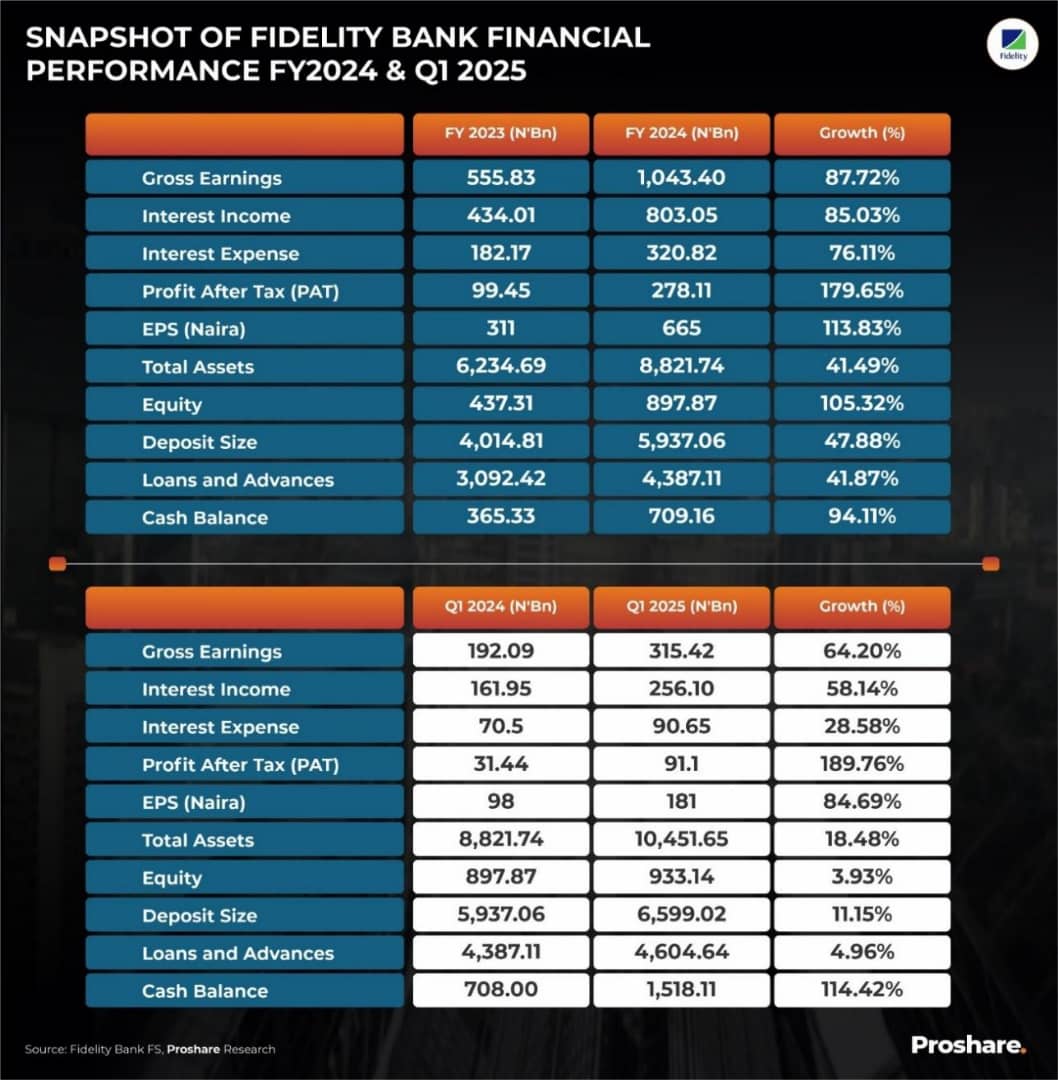
    Fidelity Bank Plc added N1.63 trillion to its assets base within three months to strengthen its position as one of the seven largest banks in Nigeria, in terms of assets base.

    Regulatory filings approved by the Central Bank of Nigeria (CBN), Securities and Exchange Commission (SEC) and the Nigerian Exchange (NGX) showed Fidelity Bank as one of the fastest growing and strongest banks in Nigeria across key parameters with the bank’s total assets rising by N1.63 trillion within the first three months of the year.

    The reports showed that Fidelity Bank’s total assets rose from N8.82 trillion by December 31, 2024 to close March 31, 2025 at N10.45 trillion. The total balance sheet underlined the bank’s reputation as one of the most preferred banking brands, with double-digit growth in customers’ deposits.

    Fidelity Bank’s customers deposit rose to N6.6 trillion by first quarter 2025 as against N5.94 trillion by December 2024. The growth in customers’ deposit base was driven by double-digit growth in low-cost deposits to N6.1 trillion, representing 92.2 per cent of total customer deposits.

    Shareholders’ funds jumped from N897.87 billion in December 2024 to N933.14 billion by March 2025. The increase was mainly driven by the significant improvement in the profitability of the bank.
    Investment experts attributed notable positive investors’ sentiment around the bank to its strong assets base and profitability, pointing out that a two-way test of assets and profitability is key measure of sustainability for a financial institution.

    In a study on ‘Balance Sheet Strength and Bank Lending During the Global Financial Crisis’, researchers at International Monetary Fund (IMF) examined the role of bank balance sheet strength in the transmission of financial sector shocks to the real economy.

    The study found that “banks with strong balance sheets were better able to maintain lending during the crisis.”

    According to the study, banks that were more dependent on market funding and had lower structural liquidity reduced the supply of credit more than other banks.

    “However, higher and better-quality capital mitigated this effect. Our results suggest that strong bank balance sheets are key for the recovery of credit following crises, and provide support for regulatory proposals under the Basel III framework,” IMF report stated.

    Fidelity Bank has remained one of the most attractive stocks at the stock market, outperforming both the average return for the entire market and particularly the banking sector.

    Fidelity Bank’s share price opened this week with a year-to-date return of 18.86 per cent, more than a double of the average capital gain in the banking sector and nearly a triple of the market’s overall average capital gain so far this year.

    The NGX Banking Index, which tracks the banking stocks, opened this week with average year-to-date return of 8.24 per cent while the All Share Index (ASI)- which tracks all share prices at the NGX, opened with a gain of 6.59 per cent.

    Market analysts said Fidelity Bank, which has remained one of the most active stocks at thee stock market, was enjoying strong positive sentiment, from existing shareholders and other investors seeking to take positions in the bank.

    A report at the NGX showed that a top director of the bank had earlier this week purchased shares worth more than N366 million, in a strategic positioning that increase the top director’s equity stake in the bank. Fidelity Bank was also the most active stock at the stock market yesterday.
    Extant regulations at the Nigerian stock market do not preclude insiders-directors, staff and other people with possible access to sensitive information, from trading in the shares of a company, but such trading must be disclosed to the market and must not be within a regulated period, otherwise known as “closed period” because of its closeness to release of sensitive information.

    Fidelity Bank had grown its pre-tax profit by 167.8 per cent to N106 billion in the first three months of this year, setting the bank on a strong growth trajectory for the year.
    Interim report and accounts of Fidelity Bank for the first quarter ended March 31, 2025 showed that profit before tax rose from N39.5 billion in first quarter 2024 to N105.8 billion in first quarter 2025. Gross earnings rose by 64.2 per cent to N315.4 billion in first quarter 2025 as against N192.1 billion in corresponding period of 2024.

    Growth in interest income was primarily led by 38.6 per cent expansion in earning assets base, while the increase in non -interest revenue came from foreign exchange (forex)-related income, trade and commission on banking services among others.

  • Fidelity Bank CEO’s Share Acquisition Signals Strong Confidence in Tier-One Lender

    Fidelity Bank CEO’s Share Acquisition Signals Strong Confidence in Tier-One Lender

    In a decisive move underscoring unwavering confidence in Fidelity Bank Plc’s resilience, Managing Director and CEO, Dr. Nneka Onyeali-Ikpe has acquired an additional 18 million shares of the bank, valued at approximately ₦366 million.

    According to a regulatory filing posted on the Nigerian Exchange Group (NGX) Disclosures portal, this strategic investment was executed at ₦20.35 per share on May 19, 2025, the same day an online platform published an unsubstantiated report on a Supreme Court ruling in a decades-long case that the bank inherited from the defunct FSB International Bank that it absorbed in 2005.

    Dr. Onyeali-Ikpe’s latest acquisition is not an isolated gesture. Between November 21 and 22, 2024, she purchased 15 million shares worth ₦239.4 million, and subsequently added another 10 million shares valued at ₦157.9 million on November 26 and 27, 2024. These cumulative investments reflect a consistent pattern of personal commitment to the bank’s long-term success.

    Demonstrating Leadership Through Personal Investment

    The CEO’s substantial personal investments serve as a powerful testament to her confidence in Fidelity Bank’s strategic direction and financial health. By increasing her stake during a period of legal scrutiny, Dr. Onyeali-Ikpe sends a clear message of stability and trust in the institution’s governance and operational integrity.

    Robust Financial Performance Reinforces Investor Confidence

    Fidelity Bank’s financial results further validate this confidence. In the first quarter of 2025, the bank reported a Profit Before Tax of ₦105.8 billion, marking a 167.8% increase compared to the same period in 2024. Gross earnings rose by 64.2% year-on-year to ₦315.4 billion, driven by significant growth in interest income and non-interest revenue.

    The bank’s balance sheet remains solid, with total deposits increasing by 11.1% year-to-date to ₦6.6 trillion, and net loans and advances growing by 5.0% to ₦4.6 trillion. These figures highlight Fidelity Bank’s strong liquidity position and its capacity to support large-scale projects and absorb financial shocks.

    Despite the rash of malicious publications on the bank that has been debunked by the Central Bank of Nigeria (CBN), Fidelity Bank’s share price has demonstrated resilience. After reaching ₦21.00 on May 13, 2025, the stock experienced a modest decline, closing at ₦20.00, a 3.8% decrease. This stability suggests that investors remain confident in the bank’s fundamentals and leadership.

    Dr. Nneka Onyeali-Ikpe’s continued investment in Fidelity Bank during a period of legal scrutiny exemplifies strategic leadership and personal commitment. Her actions not only reinforce investor confidence but also underscore the bank’s robust financial standing and resilience. As the institution looks to closing out the legal process as mandated by the court, stakeholders can take solace in the demonstrated strength and stability at the helm of Fidelity Bank.

  • Osun Residents Benefit from Fidelity Food Bank Initiative

    Osun Residents Benefit from Fidelity Food Bank Initiative

    L-R: Commissioner for Education, Osun State, Hon. Dipo Eluwole representing Governor Ademola Adeleke of Osun State; Regional Bank Head, SouthWest II, Fidelity Bank Plc, Mrs. Morenike Olabisi; Wife of Osun State Governor; Ambassador Ngozi Adeleke; Regional Operations Service Supervisor, Southwest 2, Fidelity Bank Plc, Mildred Ajepe; and Wife of the Deputy State Governor, Mrs. Olusola Adewusi; during the Fidelity Food Bank distribution in partnership with Esther Adeleke Foundation in Modakeke, Ile-Ife Community, Osun State recently.

    Over 4,500 residents have benefited from a two-day feeding programme organized by Fidelity Bank Plc in Abere and Modakeke communities in Ile-Ife, Osun State. The program, which saw to the distribution of essential food items, was executed in collaboration with the Ministry of Cooperatives and Empowerment and the Esther Adeleke Foundation.

    Speaking during the distribution event, the Managing Director/Chief Executive Officer, Fidelity Bank, Dr. Nneka Onyeali-Ikpe, represented by the Regional Bank Head, Southwest II, Mrs. Morenike Olabisi emphasized that the Fidelity Food Bank initiative underscores the bank’s commitment to Corporate Social Responsibility (CSR) and community welfare. She noted that since the initiative was launched in April 2023 by Dr Nneka Onyeali-Ikpe, it has impacted communities across all six geopolitical zones in Nigeria.

    According to Mrs Olabisi, “This is the third distribution exercise in Osun State this year, and our aim is to achieve zero hunger in Nigeria and achieve the Sustainable Development Goal 2. Our CSR initiatives are designed not just to provide immediate relief, but to empower people and improve their livelihoods. 

    “The bank will be donating 500 Point of Sale (POS) machines to the Ministry of Cooperatives and Empowerment for onward distribution to residents In addition to the food bank distribution. “These POS machines will serve as an income-generating tool for many families and small business owners across the state. Fidelity prides itself as a responsible organisation, and we place a huge premium on the wellbeing of our host communities”, she added.

    Responding to the gesture, the Governor of Osun State, Senator Ademola Adeleke represented by the Commissioner for Cooperatives and Empowerment, Bayo Ogungbangbe, commended Fidelity Bank for the social intervention programme and its continued support to the people. 

    “This is not the first time Fidelity Bank is giving back to the state and this shows that the well-being of the people is of top priority to the bank. We are deeply grateful for their sacrifice and we urge other corporate organizations to emulate Fidelity Bank on this laudable initiative”, he stated. 

    On her part, the founder of Esther Adeleke Foundation and the wife of Osun State Governor, Erelu Ngozi Adeleke, emphasized that this is the second edition of the Fidelity Food Bank in collaboration with Esther Adeleke Foundation noting that, the first edition at the Asubiaro Hospital, Osogbo inspired them to do more. 

    Her words, “My resolve to help the needy and alleviate poverty necessitated my partnership with Fidelity Bank in the distribution of food items to the needy.  There is hardship in the country, and I am doing my best to support the governor of Osun State to cater for the needs of Osun people.

    “I want to appreciate the management of Fidelity bank for their dedication to the people of Osun state, and we want to assure the bank that they have our utmost support”, she added. 

    Ranked among the best banks in Nigeria, Fidelity Bank Plc is a full-fledged Commercial Deposit Money Bank serving over 9.1 million customers through digital banking channels, its 255 business offices in Nigeria and United Kingdom subsidiary, FidBank UK Limited.

    The bank is also a recipient of multiple local and international Awards, including the 2024 Excellence in Digital Transformation & MSME Banking Award by BusinessDay Banks and Financial Institutions (BAFI) Awards; the 2024 Most Innovative Mobile Banking Application Award for its Fidelity Mobile App by Global Business Outlook, and the 2024 Most Innovative Investment Banking Service Provider Award by Global Brands Magazine. 

    Additionally, the bank was recognized as the Best Bank for SMEs in Nigeria by the Euromoney Awards for Excellence and as the Export Financing Bank of the Year by the BusinessDay Banks and Financial Institutions (BAFI) Awards.

  • The Mischief in Fidelity Bank Bankruptcy Rumour

    The Mischief in Fidelity Bank Bankruptcy Rumour

    Fidelity Bank Plc has dismissed as unfounded the story making the rounds that it is on the verge of bankruptcy following a Supreme Court judgment linked to a legacy $3 million credit facility granted by the defunct FSB International Bank in 2002.

    The bank made the clarification on Monday, assuring the general public, depositors and stakeholders that it remains financially strong despite court judgment.

    In a statement by its Divisional Head, Brand & Communications, Meksley Nwagboh, Fidelity Bank called for calm, stating that it was currently seeking judicial clarification on the accurate computation of the judgment sum.

    “By way of a background, we confirm that the issues leading up to the judgment arose from a legacy transaction between the defunct FSB International Bank and Sagecom Concepts Limited,” the bank said.

    According to the statement, FSB, a legacy bank taken over by Fidelity Bank, granted a credit facility to G. Cappa Plc in 2002 for the sum of $3 million. The facility was, in turn, secured with a mortgage on a property located in Ikoyi, Lagos.

    However, when G. Cappa defaulted, the construction company quickly commenced legal proceedings against FSB at the Federal High Court, Lagos in a bid to prevent FSB from selling the mortgaged property to repay the loan.

    Fidelity Bank’s press statement noted that the initial lawsuit was to restrain FSB from selling the property of the alleged loan defaulter.

    The Federal High Court, in its judgment, ruled that the bank, as legal mortgagor, rightfully sold the leased interest in the property to Sagecom in 2011. The Court, however, declined to order vacant possession of the property and directed the issue to the Lagos State High Court.

    In the meantime, G. Cappa remained in possession of the property and kept collecting rents.

    Sagecom’s claim against the bank was essentially for liquidated damages. In 2018, the Lagos High Court awarded judgment in favour of Sagecom against G. Cappa even when it refused to order vacant possession of the property, a judgment which was challenged at the Supreme Court by Fidelity Bank for final adjudication.

    But just like the High Court judgment, the Supreme Court ruled in favour of Sagecom.

    Fidelity Bank said it was convinced that by remaining in possession of the property and continuing to collect rents, G. Cappa created the losses suffered by Sagecom.

    However, the bank noted that after exhausting the appeal process, it is open to settling the obligation.

    In fact, enquiries by TheNiche indicate that both Fidelity Bank and Sagecom are already in talks over how the judgment debt could be paid over a mutually agreed period.

    It was this court ruling that detractors of the bank latched on in their demarketing voyage, which is what the bankruptcy story is all about.

    And in debunking the bankruptcy insinuation, the bank assured depositors and investors of its safety as a going business concern, noting that it does not have solvency or liquidity problems.

    The bank assured the public that, regardless of the Supreme Court judgment, Fidelity Bank was not under the threat of bankruptcy or liquidation.

    But that fact is rather obvious. Fidelity Bank has consistently demonstrated strong financial performance, with significant growth in key financial metrics like profit before tax (PBT), gross earnings, and net interest income. The bank is also well-capitalized, maintaining a strong capital adequacy ratio (CAR) well above the minimum regulatory requirements, which is an indication of a robust financial foundation.

    Not only that, it is also expanding its presence both within Nigeria and internationally, with a focus on digital banking and customer-centric services and the bank has received multiple awards, including for its performance in corporate banking, SMEs, and digital banking, highlighting its strength and leadership in the financial sector.

    It is therefore not surprising that it has garnered very positive investor sentiment and consequential strong support, with oversubscription in equity capital raises and a high growth rate in share prices.

    Not only that, the Central Bank of Nigeria (CBN) has weighed in on the matter, dismissing the bankruptcy story as misleading.

    In a statement on Monday night, the apex bank and regulator said its attention had been drawn to some publications and social media reports containing “misleading information regarding the operations of a regulated financial institution.”

    The statement by Mrs. Hakama Sidi Ali, Acting Director, Corporate Communications, affirmed that the CBN “continues to monitor all financial institutions under its regulatory purview and maintains robust frameworks for early warning signals and risk-based supervision. These mechanisms ensure that any emerging issues are promptly addressed to protect the integrity of the financial system.”

    The CBN urged the public to “disregard sensational or unverified claims and rely solely on official channels for information about the financial system.”

    The statement titled, “CBN reassures public on banking sector stability,” reads:

    “The attention of the Central Bank of Nigeria (CBN) has been drawn to certain publications and social media reports containing misleading information regarding the operations of a regulated financial institution.

    “The CBN wishes to categorically reassure the public, depositors, and stakeholders that the Nigerian banking sector remains resilient, safe, and sound. Like all other regulated institutions, the institution referenced in these reports is held to stringent regulatory requirements and there is no cause for concern regarding the safety of depositors’ funds.

    “The Bank affirms that it continues to monitor all financial institutions under its regulatory purview and maintains robust frameworks for early warning signals and risk-based supervision. These mechanisms ensure that any emerging issues are promptly addressed to protect the integrity of the financial system.

    “We urge the public to disregard sensational or unverified claims and rely solely on official channels for information about the financial system.

    “The CBN remains dedicated to fostering a secure banking environment where depositors can be fully confident in the safety of their funds. It will continue to monitor and adapt strategies to safeguard the financial interests of all Nigerians and stakeholders in our financial system.”

    Some financial experts who spoke to TheNiche insist that the bankruptcy story was contrived in the warped minds of those who are unable to compete and are “unnerved by the unprecedented growth of Fidelity Bank particularly under the leadership of Nneka Onyeali-Ikpe.”

    How can a bank, which is unarguably one of Nigeria’s leading Tier-1 financial institutions, a bank that has just announced a remarkable financial performance for the first quarter of 2025, recording a PBT of N105.8 billion, which represents an impressive growth of 167.8 per cent compared to N39.5 billion in Q1 2024, suddenly go bust,” asks Mr. Olamilekan Johnson, a financial expert.

    “It is all an attempt by unscrupulous people to demarket the bank. This is not the first and I am afraid, it won’t be the last. But I hope that in the interest of the country’s financial sector, they stop.”

    Johnson is right. In the wake of the revocation the banking licence of Heritage Bank Plc by the CBN on June 3, 2024, the same malicious campaign, an odious attempt to precipitate a run on Fidelity Bank, was mounted by unscrupulous people, who insinuated then, as they are doing now, that Fidelity Bank, Wema Bank, Polaris Bank and Unity Bank – will go the Heritage way.

    That was one week after the bank signed the necessary documentation to raise about N127.1 billion from a public offer and rights issue to its existing shareholders to raise its capital base in line with the CBN’s fresh capitalisation directive.

    Could it also be that this bankruptcy hoax is the panic reaction of the same naysayers who cannot relate positively to the robust fundamentals exemplified in the incredible performance of the bank as captured in its financial statements released late last month?

    The bank’s unaudited financial statements, which was released on the Nigerian Exchange (NGX) on April 30, 2025, showed a substantial increase in gross earnings, which rose to N315.4 billion, marking a year-on-year growth of 64.2 per cent from N192.1 billion in the same period last year.

    Growth in interest income was primarily led by 38.6 per cent yoy (7.4 per cent ytd) expansion in earning assets base, while the increase in non-interest revenue came from FX-related income, trade and commission on banking services, etc., supported by increased customer transactions.

    Commenting on the bank’s performance, Dr. Nneka Onyeali-Ikpe, the Managing Director/Chief Executive Officer, stated: “We started the year with triple-digit growth in profit and sustained the momentum in our earning assets growth. This performance shows the resilience of our business model and reinforces our confidence in delivering a better result in the 2025 financial year.”

    Other areas of the unaudited financial statements equally showed a marked improvement with total deposits growing by 11.1 per cent ytd to N6.6 trillion from N5.9 trillion in December 2024, driven by 10.6 per cent ytd growth in low-cost deposits to N6.1 trillion, which represents 92.2 per cent of total customer deposits.

    Local currency deposits increased by 2.0 per cent ytd while foreign currency deposits increased by 21.4 per cent from $1.9 billion in December 2024 to $2.3 billion.

    “Beginning the year with such positive momentum reinforces our commitment to supporting the growth of individuals and businesses, while enhancing our financial sustainability. As we go into the rest of the year, we remain focused on building a resilient banking franchise with a diversified earnings base,” Onyeali-Ikpe added.

    And that is exactly what Fidelity Bank is doing. Those who are purveying the bankruptcy story about Fidelity Bank Plc., a full-fledged commercial deposit money bank, serving over 9.1 million customers through digital banking channels, its 255 business offices in Nigeria and United Kingdom subsidiary, FidBank UK Limited, and ranked among the best banks in the country are only engaged in wishful thinking with no evidence or even logic to hang their delusional assumption.

    As published on thenicheng.com

  • Navy FOB Badagry Hands Over 97 Bags Of Smuggled Foreign Parboiled Rice, 191 Wraps Of Suspected Cannabis Sativa To The NCS And NDLEA

    Navy FOB Badagry Hands Over 97 Bags Of Smuggled Foreign Parboiled Rice, 191 Wraps Of Suspected Cannabis Sativa To The NCS And NDLEA


    The Nigerian Navy Forward Operating Base (FOB), Badagry, has handed over 97 bags of smuggled foreign parboiled rice and 191 wraps of suspected Cannabis Sativa to the Nigeria Customs Service (NCS) and the National Drug Law Enforcement Agency (NDLEA), respectively, as part of its ongoing high-intensity maritime security operations.

    According to a press statement released by the Commanding Officer, Navy Captain B.O. Omotayo, the contraband was seized during separate operations conducted across the Badagry – Seme – Porto Novo waterways and surrounding land corridors between April 23 and May 14, 2025.

    The seizures include:

    * 97 x 50kg bags of foreign parboiled rice intercepted on April 26, 2025.
    * 191 wraps of suspected Cannabis Sativa, weighing approximately 114.6kg, recovered in three separate operations around Packo and Bedrome–Ashipa between April 30 and May 14.
    * 307 kegs of Premium Motor Spirit (PMS), totaling about 7,675 litres, confiscated in four operations around Simtop Jetty, Tosuvi, Ashikpa, and Panshi areas between April 23 and May 3.

    In accordance with extant regulations and the Nigerian Navy’s Standard Operating Procedures, the rice was handed over to the Nigeria Customs Service, Western Marine Command, while the suspected Cannabis was transferred to the NDLEA’s Seme Special Area Command on Tuesday, May 20, for further investigation and prosecution. The intercepted PMS was destroyed to prevent illegal distribution within the area of operation.

    Captain Omotayo stated that these successes reflect FOB Badagry’s unwavering commitment to implementing the strategic directives of the Chief of the Naval Staff, Vice Admiral Emmanuel Ikechukwu Ogalla, under Strategic Directive 06–2023, which focuses on safeguarding Nigeria’s maritime environment in support of national security and economic growth.

    He emphasized the base’s resolve to sustain its fight against smuggling, narcotics trafficking, and related maritime crimes, while also reinforcing inter-agency cooperation and community engagement to foster lasting maritime security in the region.

  • Why Fidelity Bank Plc Is Too Big to Fail

    Why Fidelity Bank Plc Is Too Big to Fail

    Several media platforms have gone to town with the news of the Supreme Court ruling on a dispute between the defunct FSB International Bank and Sagecom Concepts Limited with some of them questioning the ability of Fidelity Bank (the judgement debtor) to make the payment.

    As the matter is still before the court and there’s a court order prohibiting media publications on this matter, warning that violations would constitute contempt of court, a punishable offense, we will highlight in this article why Fidelity Bank is too big to fail as alluded to by several online platforms.

    Financial Strength and Market Position

    Fidelity Bank Plc has demonstrated remarkable financial resilience, solidifying its position as one of Nigeria’s leading financial institutions. Recent reports highlight the bank’s impressive growth trajectory, including its re-entry into the N1 trillion market capitalization club and a 167.8% increase in profit before tax (PBT) to N105.8 billion in Q1 2025. Fidelity Bank’s financial performance has been exceptional, with a 64.2% year-on-year increase in gross earnings to N315.4 billion in Q1 2025. The bank’s total deposits have surged to N6.6 trillion, driven by a 21.4% increase in foreign currency deposits. These figures highlight its ability to attract and retain capital, ensuring liquidity and operational efficiency.

    Investor Confidence and Regulatory Compliance

    Fidelity Bank’s stock performance has been impressive, with a 237% oversubscription in its capital raise venture. Analysts predict continued growth, with gross earnings expected to reach N1.5 trillion and profit before tax projected at N415.4 billion in 2025. The bank’s ability to meet the N500 billion capitalization target set by the Central Bank of Nigeria (CBN) underscores its financial resilience and regulatory compliance.

    Support for Small and Medium Enterprises

    Fidelity Bank’s commitment to supporting Small and Medium Enterprises (SMEs) plays a crucial role in its significance to the economy. By providing tailored financial solutions and resources for SMEs, such as the recently launched SME Hub, the bank contributes to job creation and economic development, further cementing its importance in the financial ecosystem.

    Regulatory Compliance and Risk Management

    Fidelity Bank has demonstrated a strong commitment to regulatory compliance and risk management. By maintaining capital adequacy ratios above the required thresholds – liquidity ratio at 54.7% and capital adequacy ratio (CAR) at 20.3%, compared to the minimum requirement of 30.0% and 15.0%, respectively- the bank not only ensures its own stability but also contributes to the overall health of the banking sector.

    Strategic Expansion and International Presence

    The bank’s acquisition of Union Bank UK in 2023 marked a significant step toward international expansion. This move strengthens its global footprint and enhances its ability to serve a diverse clientele. Fidelity Bank’s leadership has also set ambitious goals to elevate the institution to tier-1 status, further reinforcing its stability and growth potential.

    It is also worth noting that global best practice allows for judgement payments of this nature to be made in installments as agreed by the relevant parties. This is to ensure that the judgement is executed to the letter in a sustainable manner.

  • Nigerian Navy Set To Commission Ships, Helicopters, And Accommodation For Junior Officers In 69th Anniversary Celebrations

    Nigerian Navy Set To Commission Ships, Helicopters, And Accommodation For Junior Officers In 69th Anniversary Celebrations

    The Nigerian Navy has unveiled a line-up of activities for its 69th Anniversary Celebration scheduled to hold from Friday, 23 May to Sunday, 1 June 2025 in Lagos. Rear Admiral Ibrahim Abdullahi Dewu, Chief of Policy and Plans at the Naval Headquarters in Abuja, made this known during an international press conference held on Monday, 19 May 2025.

    Rear Admiral Dewu stated that the Navy Week, as the celebration is popularly known, commemorates the establishment of the Nigerian Navy on 1 June 1956. According to him, the Navy has grown from a modest coastal force into a formidable maritime institution with influence in the Gulf of Guinea and sub-Saharan Africa.

    He noted that the Navy Week is also an opportunity to present the scorecard of the Nigerian Navy under the leadership of the Chief of Naval Staff, Vice Admiral Emmanuel Ikechukwu Ogalla.

    He explained that the Navy, under Ogalla, has achieved a high level of operational readiness in fulfilling its constitutional roles, especially in the fight against crude oil theft. The operation, initially launched in January 2024 as Operation Delta Sanity, was relaunched in December 2024 as Operation Delta Sanity II. The operations led to the arrest of 215 suspects, seizure of 26 vessels, and destruction of 468 illegal refinery sites in 2024 alone.

    In 2025, more than 103 illegal sites have already been destroyed, with the arrest of 34 suspects and the seizure of 39 wooden boats and one ship. So far, about 773,000 litres of crude oil and 150,000 litres of refined products have been recovered this year. Dewu stated that these achievements align with the President’s directive to eradicate oil theft and boost national oil production.

    The Nigerian Navy also maintains constant situational awareness through its Falcon Eye and Regional Maritime Awareness Capacity Systems, which have contributed to Nigeria’s zero-piracy rating in the International Maritime Bureau’s piracy assessment.

    The Nigerian Navy has taken a leadership role in regional security, hosting the 8th Symposium of Heads of Navies and Coast Guards of Gulf of Guinea nations in November 2024. The symposium discussed the operationalization of a Combined Maritime Task Force for the region.

    In February 2025, Nigeria’s Minister of Defence, Mohammed Badaru Abubakar, signed an agreement with the African Union for strategic sealift support by the Nigerian Navy. Dewu affirmed the Navy’s readiness to support AU peace operations and humanitarian missions.

    He also announced the establishment of a Special Operations Command in Makurdi, Benue State, on the North Bank of the River Benue, aimed at bolstering security in Nigeria’s Middle Belt.

    In terms of fleet renewal, the Navy will commission three new patrol vessels—NNS Shere, NNS Faro, and NNS Ikogosi—acquired from Singapore and South Korea. Additionally, three Agusta Westland 109 Trekker helicopters will be added to the Navy’s fleet, bringing the total number of helicopters to 14.

    Dewu also highlighted the Navy’s participation in international exercises, including the recently concluded Exercise Obangame Express 2025, conducted from 10 to 16 May with partner nations such as the USA, Brazil, Italy, and Spain.

    He outlined the Navy Week events, starting with Juma’at prayers on Friday, 23 May in Abuja, and an interdenominational church service on Sunday, 25 May in Lagos. Other activities include Medical Rhapsodies and outreach by the Naval Officers’ Wives Association on Monday, 26 May, a sailing competition and boat race on Wednesday, 28 May, and the unveiling of a remodeled auditorium at the International Maritime Institute of Nigeria.

    On Thursday, 29 May, naval ships will be open to public visitors in Lagos, Warri, Port Harcourt, and Calabar. On Friday, 30 May, the public will have an opportunity to go onboard ships for sea cruises, and there will also be a golf tournament at the Dolphin Golf Club in Navy Town, Lagos.

    The commissioning of ships, helicopters, and accommodation for junior officers will take place on Saturday, 31 May at NNS Beecroft, Apapa, Lagos, while the celebration will end on Sunday, 1 June with a ceremonial sunset and dinner at the Naval Dockyard in Victoria Island, Lagos.

    Rear Admiral Dewu appreciated the media for its continued support and called on journalists to give adequate publicity to the Navy Week activities.

    He then opened the floor for questions from members of the press.

  • IDIROKO: Nigeria Customs Service Pledges Seamless Business Activities Along Igolo Border Corridor

    IDIROKO: Nigeria Customs Service Pledges Seamless Business Activities Along Igolo Border Corridor

    …Calls for Synergy Among Importers Exporters and Clearing Agents

    The Ogun I Command of the Nigeria Customs Service, under the leadership of the dynamic Comptroller GA Otunla, recently hosted a high-level stakeholder engagement session focused on enhancing trade facilitation along the Idiroko-Igolo border corridor.

    This statement signed by Chado Zakarix Deputy Superintendent of Customs reads that the event was held at the Command’s conference room, the strategic meeting brought together key players in cross-border trade, including representatives from the Benin Republic Customs Authority, trade associations, business leaders, clearing agents from both Nigeria and Benin Republic, the Association of Nigerian Licensed Customs Agents (ANLCA), and Customs liaison officers.

    The dialogue centered on improving customs cooperation and streamlining business processes to foster the smooth flow of legitimate trade across the corridor.

    In his opening remarks, Comptroller Otunla emphasized the significance of Nigeria-Benin economic ties, stating that the economic relationship between Nigeria and Benin Republic is not only vital to our bilateral engagements but also to the broader West African sub-region. We share a long history of trade and economic cooperation which must continue to thrive in a secure and orderly environment.

    He acknowledged the existing challenges that hinder trade, including border inefficiencies, regulatory bottlenecks, and security concerns—issues, he affirmed must be addressed to restore the vibrant commercial activity witnessed before the border closure.

    According to Comptroller Otunla, the objective of the meeting was to foster candid dialogue, identify obstacles, and co-create practical, implementable solutions that would promote lawful trade across the Igolo–Idiroko corridor.

    During the interactive session, stakeholders highlighted several impediments affecting business activities at the border, including: Multiple checkpoints, poor road infrastructure, Inadequate space for handling large volumes of containers, Tariff and non-tariff barriers, absence of effective dispute resolution mechanisms and persistent security challenges

    Following the discussions, participants inspected a one-hectare site provided by the Command, which is capable of accommodating over 30 containers—an infrastructural step forward toward easing cargo flow.

    Stakeholders expressed optimism and agreed that with the measures and assurances provided by the Command, Idiroko would soon experience a resurgence in legitimate cross-border trade.

    In his closing remarks, Comptroller Otunla reaffirmed his commitment to immediate action in line with the policy thrust of the Comptroller General of Customs, Bashir Adewale Adeniyi, MFR, which emphasizes cooperation and collaboration, I pledge to utilize all powers within my office to implement the resolutions reached during this engagement.

  • Eastern Naval Command Boosts Personnels Proficiency With Small Arms Firing Exercise To Prepare Troops For Combat Scenarios

    Eastern Naval Command Boosts Personnels Proficiency With Small Arms Firing Exercise To Prepare Troops For Combat Scenarios


    In line with Nigerian Navy schedule of events 2025, Headquarters Eastern Naval Command kicks off a 3-day small arms firing exercise which started on Wednesday 14 and ended Friday 16 May 2025 at the Nigerian Police Shooting Range in Asabanka community, in Calabar.

    The exercise which aims to:
    Enhance marksmanship skills , Improve weapon handling and safety, Prepare troops for combat scenarios and Maintain operational readiness, commenced with the kickoff shot fired by Rear Admiral DM Ndanusa who represented the Flag Officer Commanding Eastern Naval Command Rear Admiral SA Akinwande.

    All units under Eastern Naval Command in Calabar Area and the Naval War College of Nigeria participated in the 3 days exercise.
    The exercise was designed to enhance the professionalism and mission readiness of naval personnel in response to emerging security threats.

    The exercise included full-scale live-fire drills, with participants firing various weapons at different distances, ranging from 200m, 100m, and 50m respectively. The exercise equally reinforced cooperation as some Nigerian Army gunnery instructors from the Nigeria Army 13 Brigade were invited for the exercise.

    Participants were grouped into 10-man syndicates, allowing for effective supervision and guidance, testing their marksmanship skills.
    The Flag Officer Commanding, Eastern Naval Command Rear Admiral SA Akinwande, in his closing remarks emphasized the importance of such exercises in maintaining personnel proficiency and enhancing operational readiness.

    The Firing Exercise was a resounding success, demonstrating the Eastern Naval Command’s commitment to enhancing the professionalism and mission readiness of personnel.

  • CSOs Calls For Bold Global Action And Domestic Reform Ahead Of UN Financing For Development Conference

    CSOs Calls For Bold Global Action And Domestic Reform Ahead Of UN Financing For Development Conference

    As preparations intensify for the Fourth International Conference on Financing for Development (FfD4), scheduled for June 30, 2025, in Seville, Spain, Nigerian civil society organisations are making a strong case for transformative global reforms and urgent domestic action to address the persistent financing challenges facing the Global South.

    This call is contained in a newly released report titled “Financing for Development in Nigeria: Sectoral Context and Insights for the Fourth International Conference”—an advocacy position paper developed by the Civil Society Legislative Advocacy Centre (CISLAC), in partnership with Oxfam in Nigeria, Christian Aid, International Budget Partnership, Tax Justice & Governance Platform, Connected Development, and other key partners under the Africa Agenda on Financing for Development (Agenda Afrique).

    The report presents a sobering analysis of Nigeria’s development trajectory, warning that: “Nigeria faces a multidimensional financing gap, driven by underperforming domestic resource mobilization, inequitable global financial rules, and increasing vulnerability to climate change.”

    It notes that critical sectors such as education, health, agriculture, and climate resilience remain chronically underfunded. “Education spending falls below UNESCO benchmarks, health expenditure remains under 4% of GDP, and the country loses over $18 billion annually to illicit financial flows,” the document states. “Meanwhile, Nigeria’s debt service-to-revenue ratio has now exceeded 70 percent, leaving little room for investment in people.”

    The report also emphasizes that while international frameworks such as the African Union’s Agenda 2063, ECOWAS Vision 2050, and the United Nations Sustainable Development Goals (SDGs) offer a shared vision for progress, the real struggle lies in resource mobilization. “The issue is not a lack of frameworks, but rather a lack of effective implementation due to several core problems,” the report asserts, citing corruption, poor budget implementation, outdated development data, and weak public financial management systems as recurring challenges.

    It laments that most Nigerian states do not have measurable development blueprints, making it difficult to track progress or attract meaningful investments. “Without decisive and deliberate efforts to bridge these financing gaps at both national and sub-national levels, Nigeria will continue to fall behind,” the document warns.

    Nigeria is also using the platform of the upcoming FfD4 to call for major reforms in the international financial architecture. The country advocates for changes to global tax rules, easier access to climate finance, and new concessional financing frameworks that reflect the needs of countries with large populations living in poverty. “We urge the international community to prioritise loss and damage financing, equitable access to green investments, and reform of Special Drawing Rights (SDRs) to better support middle-income countries carrying high poverty burdens,” the report adds.

    On the domestic front, the report outlines a range of policy proposals to enhance Nigeria’s financial capacity. These include adopting digital tax systems for fair taxation, simplifying trade processes to drive industrialisation, launching anti-corruption and asset recovery campaigns, and establishing development finance facilities to de-risk private investment in infrastructure and social services. It also calls for the institutionalisation of peer learning platforms to encourage innovation in sub-national financing strategies.

    The report draws urgent attention to Nigeria’s worsening brain drain crisis. “The continued migration of Nigeria’s skilled workforce, especially young professionals, is directly linked to the lack of inclusive economic opportunities at home. If we fail to invest in youth-centred policies and job creation, our best minds will continue to seek prosperity elsewhere.”

    As the world gears up for FfD4, Nigeria is positioning itself to take a leadership role in shaping the future of global development finance. The report concludes with a call to action: “This moment is pivotal. As the global community gathers to renew its financing commitments, Nigeria stands ready to champion equity, accountability, and inclusion in the international financial system. The upcoming FfD4 conference presents a critical opportunity to reshape global financing and unlock the investments required for a just and resilient future.”

error: Content is protected !!