Category: News

  • Assessing Two Years Of President Tinubu’s Administration Across Nigeria’s Executive, Legislature, And Judiciary

    Assessing Two Years Of President Tinubu’s Administration Across Nigeria’s Executive, Legislature, And Judiciary

    As President Bola Ahmed Tinubu marks two years in office, a comprehensive mid-term assessment by the Civil Society Legislative Advocacy Centre (CISLAC), the Nigerian chapter of Transparency International, presents a complex picture of governance marked by reform ambitions intertwined with persistent challenges across Nigeria’s executive, legislative, and judicial branches. The report highlights an administration grappling with economic transformation and security management while facing increasing public dissatisfaction and democratic erosion.

    Economically, the Tinubu administration has pursued bold reforms, including the removal of fuel subsidies and unification of exchange rates, which have won praise from international financial institutions. Nigeria’s foreign reserves have risen to over $37 billion, and foreign investment is tentatively returning. Yet for ordinary Nigerians, the harsh realities of these reforms have manifested in soaring inflation surpassing 33 percent, a doubling of food prices, and stagnant real wages. The absence of a comprehensive social safety net has exacerbated poverty and deepened the crisis of survival, exposing a dissonance between macroeconomic recovery indicators and everyday hardships experienced by the populace. This economic strain has contributed to widening inequality and heightened public discontent.

    According to the Signed press statement by Comrade Auwal Musa Rafsanjani, Executive Director, Civil Society Legislative Advocacy Centre (CISLAC) “The government’s handling of civil liberties has drawn sharp criticism. The Tinubu administration’s response to increasing dissent has been heavy-handed, with crackdowns on protesters, including minors, and restrictions on peaceful assembly becoming commonplace. Despite constitutional protections for freedom of expression and assembly, the narrowing civic space signals a troubling drift toward authoritarianism. Security concerns are frequently cited as justification for repression, yet CISLAC warns this growing securitization of governance risks undermining fundamental democratic rights and weakening the nation’s social fabric.

    Security remains one of the administration’s most daunting challenges. Despite expanded defense budgets and the creation of new security outfits like the Forest Security Service, violence persists across key regions, including Zamfara, Kaduna, Plateau, and parts of the South-East. Kidnappings, killings, and clashes have not abated, underscoring the limited impact of military deployments unsupported by effective intelligence reform. CISLAC advocates for a paradigm shift toward integrated security approaches emphasizing inter-agency collaboration, community policing, transparent procurement, and rebuilding public trust in law enforcement, which remain crucial for long-term peace and stability.

    On anti-corruption efforts, the government has maintained some institutional mechanisms such as project tracking and procurement monitoring. The Independent Corrupt Practices Commission (ICPC) has monitored over 1,700 projects with some fund recoveries reported. However, the campaign is marred by selective enforcement, notably the failure to prosecute high-profile figures such as former Kogi Governor Yahaya Bello and the frequent defections of opposition politicians into the ruling party to avoid prosecution. This pattern has undermined the integrity of the anti-corruption drive and fed public cynicism about equal application of justice. CISLAC describes the campaign as weakened by double standards and stresses that impartiality is essential for meaningful progress.

    The judiciary, as Nigeria’s third arm of government, faces persistent structural challenges despite commendable strides in filling judicial vacancies, digitalizing court processes, and ruling on electoral disputes. Backlogs, inconsistent verdicts, selective accountability, and executive interference have continued to erode public confidence in the justice system. The judiciary’s constitutional guarantees of financial and operational autonomy remain largely unrealized, with many state governments failing to domesticate critical laws such as the Administration of Criminal Justice Act. In a political climate characterized by increasing authoritarian tendencies and disregard for court orders, the judiciary’s independence is vital to safeguard civil liberties and uphold the rule of law. CISLAC warns that any further erosion of judicial impartiality risks accelerating impunity and democratic backsliding.

    Agriculture, a vital sector for food security and employment, paints a similarly uneven picture. Despite the government’s declaration of a food emergency in 2023 and interventions like the “Earn from the Soil” initiative, over 31 million Nigerians remain food insecure, especially in conflict-affected zones. Budget allocations have not translated into commensurate agricultural output due to insecurity in farming regions, diversion of inputs, and inadequate access to credit and infrastructure. CISLAC emphasizes that without addressing land safety, rural development, and market access beyond seasonal handouts, sustainable food security will remain elusive.

    The administration’s appointment pattern has also attracted criticism for lack of inclusivity and failure to uphold the federal character principle. Key positions have been filled with apparent regional bias, sidelining women and other marginalized groups. While competence is essential, appointments that disregard Nigeria’s ethnic, religious, gender, and generational diversity threaten national cohesion and unity, undermining the government’s broader stability agenda.

    Employment and poverty continue to be critical concerns. Though the Student Loans Act signals some progress in educational financing, it falls short of addressing Nigeria’s structural unemployment and the escalating brain drain, popularly known as “Japa.” CISLAC contends that this exodus reflects economic despair rather than a lack of patriotism. The government must urgently focus on job creation, entrepreneurship, and industrialization to stem the loss of Nigerian talent and ensure sustainable development.

    Social services remain underdeveloped despite increased budgetary allocations. Public education quality is deteriorating, and healthcare services remain largely inaccessible to the poor. Infrastructure improvements are largely symbolic, often lauded in press briefings rather than felt in everyday life. The national power grid remains unreliable, and rural electrification lags far behind expectations. CISLAC underscores that genuine progress must be measured by tangible improvements in citizens’ daily lives, not by superficial ceremonies or social media campaigns.

    The 10th National Assembly, running concurrently with Tinubu’s administration, embodies both the promise and challenges of Nigeria’s democracy. The legislature plays a critical role not only as a lawmaking body but also as a forum for representation, checks and balances, policy scrutiny, and accountability. During this period, the Assembly has recorded some legislative activism, passing key bills, engaging constitutional amendments, and establishing committees to tackle national concerns. Notable efforts to enhance public participation and electoral reforms have been undertaken, along with oversight of security and economic challenges.

    Yet, the Assembly’s record is marred by political dysfunction, including internal controversies, suspensions of members, allegations of executive interference, legislative gridlock, and defections that weaken democratic accountability. The failure to decisively address major national issues such as insecurity, corruption, and youth unemployment reveals a troubling disconnect between lawmakers and citizen expectations. The suspension of Senator Natasha Akpoti-Uduaghan, and the apparent weaponization of legislative privileges, have raised questions about the Assembly’s commitment to fairness and democratic norms. These actions risk undermining the constitutional guarantees of representation and free speech.

    Moreover, the legislature has often shown insufficient independence from the executive branch. Oversight of critical policies has been tepid, responses to emergency declarations have been muted, and resistance to centralization of power remains weak. The House of Representatives, despite passing numerous bills, has sometimes failed to secure complementary Senate action, leading to legislative paralysis that stalls national progress. Issues such as land racketeering and informal taxation in Abuja’s Federal Capital Territory expose governance gaps that legislative committees have yet to fully address.

    Political defections motivated more by personal survival than ideology further erode public trust and weaken party systems, deepening democratic fragility. Despite these setbacks, the 10th National Assembly still holds the potential to reassert its mandate through bold legislative action, robust oversight, and constitutional reform. This midterm review serves as a call for lawmakers to prioritize national interest above partisan or personal ambitions and to renew their commitment to the Constitution and the Nigerian people.

    In this delicate democratic moment, the judiciary’s role is paramount. It must recommit to independence, impartiality, and the rule of law to serve as the final safeguard of democracy. Courts should be sanctuaries of justice, free from political manipulation, ensuring that citizens’ rights are protected, and that the government remains accountable.

    CISLAC’s mid-term report concludes that while President Tinubu has initiated important reforms aimed at economic stability and governance, the administration’s overall performance is undermined by implementation gaps, rising authoritarianism, and insufficient empathy for citizens’ hardships. The Centre urges a shift toward people-centered policies, including increasing the minimum wage, comprehensive judicial and security sector reforms, equitable anti-corruption enforcement, and renewed investments in agriculture, infrastructure, and social services.

    The next two years present a critical window for Nigeria to recalibrate its governance trajectory. Only through strengthened democratic institutions, transparency, and inclusion can the administration restore public trust and deliver on the promise of a prosperous and unified Nigeria. For civil society, media, and citizens, the challenge is to sustain engagement and pressure to ensure accountability and a government that truly serves its people.

  • TMG Raises Alarm Over Political Interference, Calls For Upholding Of Ogban Conviction

    TMG Raises Alarm Over Political Interference, Calls For Upholding Of Ogban Conviction

    The Transition Monitoring Group (TMG), a coalition of over 200 civil society organisations committed to deepening electoral accountability and democracy, has expressed grave concern over emerging attempts by the political class to manipulate the fallout from the recent electoral fraud conviction involving Professor Peter Ogban, a former returning officer in the 2019 Akwa Ibom North-West senatorial election, who falsified election results in favour of then-APC candidate, Senator Godswill Akpabio.

    TMG, the foremost independent civil society election observation organisation in Nigeria, was part of the coalition that earlier called for Senate President Godswill Akpabio to step down. It is now warning that ongoing efforts to derail justice threaten to undermine the rule of law and erode public trust in Nigeria’s democratic process.

    In a statement issued on Wednesday and signed by its Chairman, Comrade Auwal Musa Rafsanjani, TMG said it was deeply troubled by what it described as a deliberate effort by political elites to suppress justice and shield those responsible for electoral fraud from facing consequences.

    “We are alarmed that despite the clear ruling of the Court of Appeal upholding the conviction of Professor Ogban, there appears to be a coordinated attempt to neutralize the impact of the judgment and protect the beneficiaries of the fraud,” the coalition said.

    Professor Ogban was sentenced to three years in prison for falsifying election results to favour Senator Akpabio. The Court of Appeal sitting in Calabar recently affirmed the conviction, prompting renewed calls from CSOs, including TMG, for Senator Akpabio to step aside from his current position as President of the 10th Senate.

    TMG emphasized that the rulings of both the High Court and the Court of Appeal must be implemented and respected until potentially overturned by the Supreme Court. “Ignoring judicial rulings in a bid to protect political interests sets a dangerous precedent. The rule of law is non-negotiable in any democratic society,” the statement added.

    The coalition reiterated its demand for full accountability, including the public disclosure and prosecution of all electoral offenders. “Until people begin to face real consequences for subverting the electoral process, Nigeria will continue to suffer from voter apathy and democratic decay,” TMG warned.

    The group further stated that the conviction of the returning officer who declared Akpabio the winner calls into serious question the legitimacy of that mandate. “The matter goes beyond individual accountability—it is about protecting the integrity of our institutions and restoring public confidence in elections,” TMG stressed.

    TMG also commended the Independent National Electoral Commission (INEC) and former Akwa Ibom Resident Electoral Commissioner Mike Igini for their role in pursuing the case, and called on political and judicial authorities to resist any pressure to dilute the outcome.

    “This is not the time for silence or compromise. The judiciary has done its part. Now the political leadership, INEC, and the National Assembly must show Nigerians that no one is above the law,” TMG concluded.

  • CNS Commissions New Official Residences For Senior Naval Officers In Apapa

    CNS Commissions New Official Residences For Senior Naval Officers In Apapa

    In a move aimed at enhancing the welfare of naval personnel, the Chief of the Naval Staff (CNS), Vice Admiral Emmanuel Ikechukwu Ogalla, on Tuesday, May 28, 2025, commissioned a newly constructed official accommodation complex for senior officers of the Accounts and Budget Branch of the Nigerian Navy.

    The facility, located at Tamandu Barracks in the Government Reserved Area (GRA), Apapa, comprises five units of fully furnished three-bedroom duplexes. It is part of ongoing efforts by the Nigerian Navy to provide decent housing for its personnel and improve their standard of living.

    Speaking during the commissioning ceremony, Vice Admiral Ogalla commended the Chief of Accounts and Budget for the successful delivery of the project, describing it as a clear demonstration of the Navy’s commitment to the welfare of its officers and men.

    “This edifice is not just a building but a testament to our focus on enhancing personnel welfare and fostering a motivated and efficient workforce,” he said. He encouraged the officers to uphold professionalism and treat the accommodation as their personal homes. “To whom much is given, much is expected,” he added, urging them to maintain the facility with care and responsibility.

    The CNS officially handed over the new accommodation to the Chief of Accounts and Budget and expressed confidence that the initiative would contribute positively to operational efficiency and officer morale.

    The commissioning is one of several projects aligned with the Navy’s broader vision of improving the quality of life for its personnel and underscores the importance of infrastructure development in sustaining military effectiveness.

  • NAVY @69: FOB Badagry Takes Free Medical Outreach To Topo Community In Celebrations

    NAVY @69: FOB Badagry Takes Free Medical Outreach To Topo Community In Celebrations


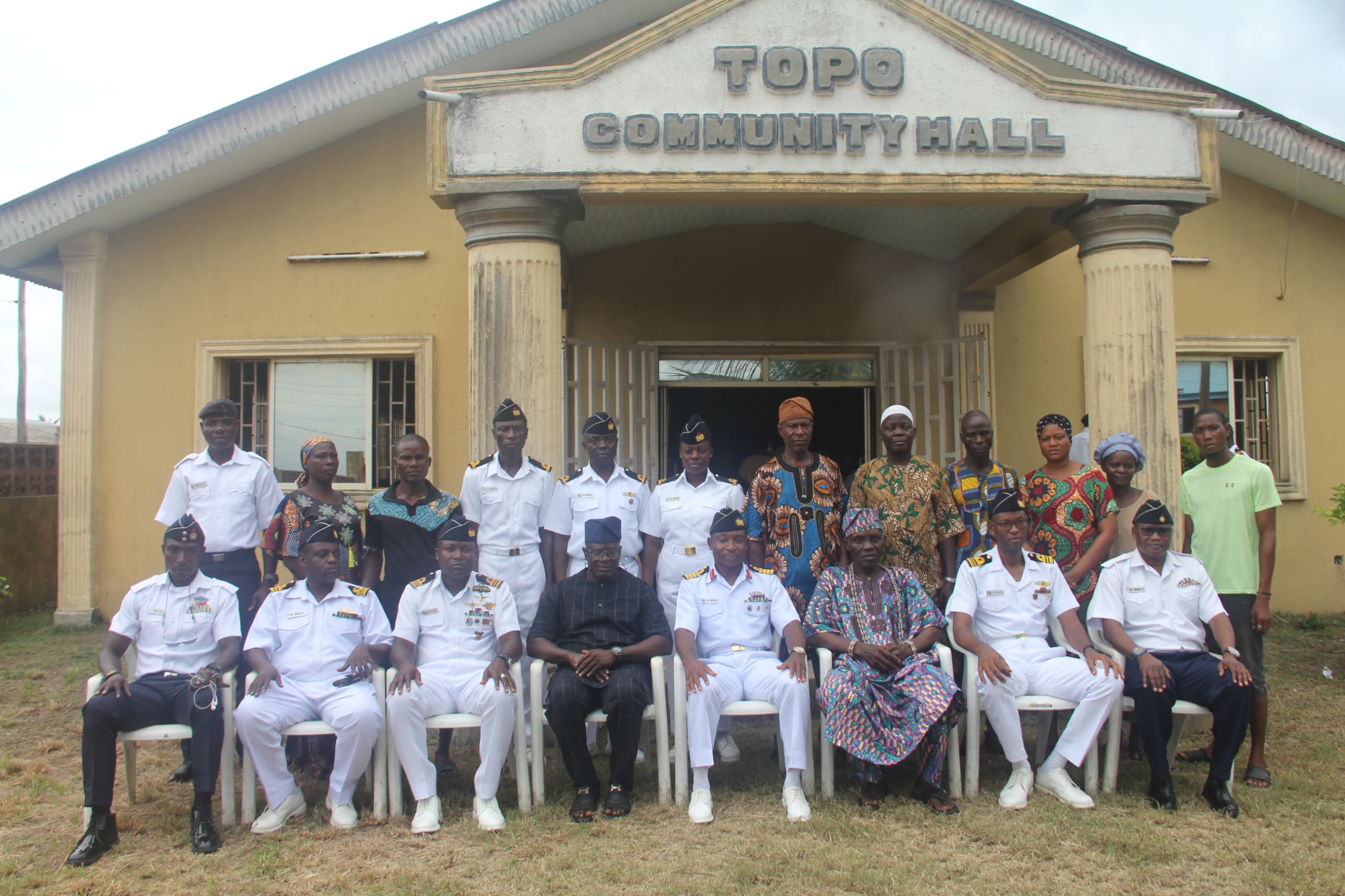
    In commemoration of the Nigerian Navy’s 69th Anniversary, the Nigerian Navy Forward Operating Base (FOB) Badagry on Wednesday, 28 May 2025, carried out a medical outreach tagged “Medical Rhapsody” in Topo Village, Badagry. The initiative, conducted as part of the Navy’s corporate social responsibility, aimed to bring healthcare services closer to underserved members of the community.

    According to Navy Captain BO Omotayo, Commanding Officer of FOB Badagry, the outreach provided free medical consultations, blood pressure checks, and essential medications to residents, with special attention given to the less privileged. He stated that the medical intervention aligns with the Navy’s broader goal of nation-building beyond its traditional security mandate.

    “This outreach demonstrates the Nigerian Navy’s unwavering commitment to humanitarian service and nation-building. It is our duty not only to protect our maritime environment but also to contribute to the well-being of our host communities,” Omotayo said.

    The commanding officer commended the dedicated medical team who, he noted, worked tirelessly to ensure the success of the outreach. He also appreciated the support of the Navy’s partners and the people of Topo for their hospitality and active participation in the programme.

    Highlighting the broader mission of the Nigerian Navy, Omotayo reaffirmed the Navy’s dedication to professionalism, discipline, and community service, in line with the Chief of the Naval Staff, Vice Admiral Emmanuel Ikechukwu Ogalla’s Strategic Directive 06-23. He stressed the Navy’s commitment to maritime safety and to fostering closer ties with communities like Topo.

    “To our host community—the good people of Topo Village—we are honoured to serve you, and we look forward to a brighter future together,” Omotayo concluded.

    The event added a human touch to the Navy’s anniversary celebration, demonstrating the service’s evolving role in community engagement and public welfare.

  • Fidelity Bank Celebrates Children’s Day with Launch of Read2Lead Anthology and Scholarship Awards

    Fidelity Bank Celebrates Children’s Day with Launch of Read2Lead Anthology and Scholarship Awards

    In a vibrant celebration of this year’s Children’s Day, leading financial institution Fidelity Bank Plc unveiled its Read2Lead Anthology—an inspiring collection of essays written by young Nigerians as part of the bank’s flagship literacy initiative.

    Held at the Fidelity Grounds in Oniru, Lagos, the event was themed “The Fidelity Fantasyland 3.0” and drew hundreds of students, parents, and educators. The day was packed with fun-filled activities—from dancing competitions and face painting to arcade games and singing contests—creating lasting memories for the children in attendance.

    A major highlight of the celebration was the official launch of the Read2Lead Anthology, which features superhero-themed essays written by 30 outstanding finalists from across the country. The stories, centered on the theme “Naija Superheroes”, showcase the imagination, intellect, and storytelling talent of Nigerian youth.

    Addressing the audience, Dr. Nneka Onyeali-Ikpe, Managing Director and Chief Executive Officer of Fidelity Bank Plc, applauded the efforts of the more than 3,000 students who participated in the maiden edition of the Read2Lead competition.

    “Today is more than just the conclusion of a competition,” she said. “It is a celebration of vision, hard work, and potential. Through Read2Lead, we provided books, writing tools, and opportunities for creative expression to thousands of young Nigerians—helping them to read more deeply, write more clearly, and think more creatively. This initiative reflects our belief that education is one of the most powerful tools for transforming lives and shaping the future.”

    She described the anthology as “a powerful testament to the promise of Nigeria’s next generation.”

    “As you turn the pages of this collection,” Dr. Onyeali-Ikpe continued, “I invite you to see these stories not just as words, but as seeds—seeds of wisdom, leadership, character, and a brighter tomorrow.”

    In further celebration of excellence, Fidelity Bank awarded scholarships worth ₦150,000 each to four outstanding pupils—Thiago Chukwudubem Agada, Nabeela Nia Rufai, Victory Alize Chukwuebuka, and Osinachi Olivia Onyeaghala—selected through the Fidelity Savings Loyalty Scheme (FSLS). These awards underscore the bank’s continued commitment to supporting education and rewarding academic dedication.

    With laughter, learning, and literary celebration, the Fidelity Fantasyland 3.0 event brought joy and purpose together—leaving children inspired, parents proud, and everyone reminded that investing in the minds of our youth is the surest path to a better future.

    Ranked among the best banks in Nigeria, Fidelity Bank Plc is a full-fledged Commercial Deposit Money Bank serving over 9.1 million customers through digital banking channels, its 255 business offices in Nigeria and United Kingdom subsidiary, FidBank UK Limited.

    The Bank is the recipient of multiple local and international Awards, including the 2024 Excellence in Digital Transformation & MSME Banking Award by BusinessDay Banks and Financial Institutions (BAFI) Awards; the 2024 Most Innovative Mobile Banking Application award for its Fidelity Mobile App by Global Business Outlook, and the 2024 Most Innovative Investment Banking Service Provider award by Global Brands Magazine. Additionally, the Bank was recognized as the Best Bank for SMEs in Nigeria by the Euromoney Awards for Excellence and as the Export Financing Bank of the Year by the BusinessDay Banks and Financial Institutions (BAFI) Awards.

  • Fidelity Bank Wins ‘Most Improved Commercial Bank’ at Inaugural Nairametrics Capital Market Choice Awards

    Fidelity Bank Wins ‘Most Improved Commercial Bank’ at Inaugural Nairametrics Capital Market Choice Awards

    For its outstanding financial performance and strategic growth, Fidelity Bank Plc, a leading tier-one financial institution, has been honoured with the Most Improved Commercial Bank of the Year award at the inaugural Nairametrics Capital Market Choice Awards.

    Organized by Nigeria’s premier financial media platform, Nairametrics, the awards were launched to recognize individuals, institutions, and policy reforms that have significantly shaped Nigeria’s capital markets. The initiative seeks to spotlight excellence in areas such as regulatory leadership, corporate governance, investment performance, and financial innovation.

    “This award is a testament to the tremendous work we are doing at Fidelity Bank—not only in delivering superior service to our customers, but also in driving economic growth and creating sustainable value for all stakeholders,” said an elated Dr. Nneka Onyeali-Ikpe, Managing Director and Chief Executive Officer of Fidelity Bank Plc. “We are deeply grateful for this recognition and remain committed to helping individuals grow, businesses thrive, and economies prosper.”

    The awards ceremony, held on Friday, May 23, 2025, at the Banquet Hall of the Civic Center in Lagos, drew an esteemed audience, including Dr. Jumoke Oduwole, Honourable Minister of Industry, Trade and Investment, as well as industry leaders, regulators, media executives, and capital market stakeholders.

    Delivering the keynote address, Dr. Emomotimi Agama, Director-General of the Securities and Exchange Commission (SEC), underscored the need for continuous evolution in financial markets. “Markets must become more efficient, secure, and innovative to fulfill their promise. In Nigeria, we are committed to building a resilient, inclusive, transparent, and future-ready capital market,” he stated.

    Ugo Obi-Chukwu, Founder and CEO of Nairametrics, shared the vision behind the awards, saying, “The Capital Market Choice Awards is our way of reinforcing the core values that sustain a healthy capital ecosystem—trust, performance, and progress.”

    Fidelity Bank’s recognition comes on the heels of a stellar 2024 financial year. The bank posted an exceptional 210% growth in Profit Before Tax (PBT), reaching ₦385.2 billion—the largest year-on-year PBT increase recorded in the Nigerian banking industry for the year.

    Further demonstrating its leadership, Fidelity Bank spearheaded the Central Bank of Nigeria’s recapitalization drive with a highly successful Public Offer and Rights Issue, which were oversubscribed by 237.9% and 137.7% respectively—solidifying investor confidence in the bank’s strategic direction.

    Ranked among the best banks in Nigeria, Fidelity Bank Plc is a full-fledged Commercial Deposit Money Bank serving over 9.1 million customers through digital banking channels, its 255 business offices in Nigeria and United Kingdom subsidiary, FidBank UK Limited.

    The Bank is the recipient of multiple local and international Awards, including the 2024 Excellence in Digital Transformation & MSME Banking Award by BusinessDay Banks and Financial Institutions (BAFI) Awards; the 2024 Most Innovative Mobile Banking Application award for its Fidelity Mobile App by Global Business Outlook, and the 2024 Most Innovative Investment Banking Service Provider award by Global Brands Magazine. Additionally, the Bank was recognized as the Best Bank for SMEs in Nigeria by the Euromoney Awards for Excellence and as the Export Financing Bank of the Year by the BusinessDay Banks and Financial Institutions (BAFI) Awards.

  • CNS Ogalla Expressed Delight Over The Progress Recorded By Nigerian Navy, Reaffirmed Commitment To Repositioning For Enhanced Maritime Security And National Development

    CNS Ogalla Expressed Delight Over The Progress Recorded By Nigerian Navy, Reaffirmed Commitment To Repositioning For Enhanced Maritime Security And National Development

    … As Clergy Emphasize Unity, Gratitude At Interdenominational Church Service In Navy Town

    As part of activities marking the 69th anniversary of the Nigerian Navy, a solemn interdenominational thanksgiving service was held on Sunday at Our Lady Star of the Sea Catholic Church, Navy Town, Ojo, Lagos. The spiritually uplifting gathering brought together naval personnel, their families, and well-wishers in an atmosphere of gratitude, reflection, and renewed commitment to peace and unity.

    The service was officiated by a team of dedicated military clergy including Very Reverend Father (Capt) Richmond Diala, Reverend Father (CDR) JO Ukpogu, Rev. Fr. (Lt CDR) MM Vandu, Rev. Fr. (Lt CDR) J Elises, Rev. Fr. (Lt CDR) BM Benson, Rev. Fr. (Lt CDR) S Kogi, and Rev. Fr. (Lt CDR) ZO Adebayo.

    The First Reading was taken by the Flag Officer Commanding (FOC) Naval Doctrine Command (NAVDOC), while the Responsorial Psalm was led by Lt. OR Ukachukwu-Eke. The Second Reading was delivered by the FOC Western Naval Command (WNC), and the Gospel was proclaimed by Rev. Fr. (Lt CDR) MM Vandu. Rev. Fr. (Lt CDR) BM Benson led the general intercessions, and the service concluded with prayers and benediction by Rev. Fr. (CDR) JO Ukpogu.

    In his homily titled *“TOGETHER”*, Rev. Fr. (Capt) Richmond Diala delivered a deeply reflective message, calling for national and institutional introspection.

    “This celebration is a call to consciousness,” he declared. “It’s not a new message, but a reminder—a reaffirmation of what we already know. On a day like this, I ask: what has sustained the Nigerian Navy? What has sustained Nigeria as a country? And what will sustain us in the future? The answer is togetherness.”

    Fr. Diala emphasized the importance of unity across religious, ethnic, and institutional divides. He recalled past predictions that Nigeria would disintegrate by certain milestones, yet the country remains intact. “Is that not enough for us to thank God?” he asked the congregation, urging all present to embrace gratitude and maintain hope.

    “A good Christian can never be a bad soldier,” he added, encouraging service members to remain steadfast in faith while upholding their military responsibilities.

    The homilist’s delivery, laced with humor, personal anecdotes, and emotional appeals, drew laughter, reflection, and spontaneous applause from the congregation. He spoke of his years in ministry and the inspiration he has drawn from the resilience of service members and citizens alike. Quoting a Nigerian saying, he reminded the congregation: “If you don’t know who you are, you may never know where you’re going.”

    In his remarks, Vice Admiral Ikechukwu Emmanuel Ogalla expressed delight over the progress recorded by the Nigerian Navy and reaffirmed the service’s commitment to repositioning for enhanced maritime security and national development.

    He stated: “I’m delighted to make this remarks on this special occasion on the commemoration of the Nigeria Navy 69th Anniversary Celebration. It is through the mercy of God that we all are able to witness this year’s anniversary. Over the years, we have continued to develop the Nigerian Navy in order to reposition ourselves to curb rising security challenges facing our nation and the West African Sub-Region in general.

    In line with our strategic plans and objectives, we have focused on capacity building, acquisition of platforms, infrastructural development, and the welfare of our personnel and civilian staff. While this development drive will be sustained towards operational effect, efficiency, and effectiveness of the service, it is imperative that we remain prayerful, steadfast, and focused. It is also important that we remain peace-loving and law-abiding citizens, and abide by the principles that foster unity in our nation.

    The Holy Bible, in II Chronicles 7:14, says, ‘If my people who are called by my name shall humble themselves and pray and seek my face and turn from their wicked ways, then will I hear from heaven, I will forgive their sins and will heal their land.’ As we gather here today, let us pray for Nigeria, let us also pray for the Nigerian Armed Forces and the Nigerian Navy in particular, that the Almighty God will continue to heal our land and grant us the grace to carry out our roles for the good of the people.”

    He emphasized that the Navy under his leadership will continue to prioritize welfare and enhance operational efficiency through the acquisition of modern platforms and tools necessary for optimal performance.

    “During this anniversary celebration,” he revealed, “we will be commissioning three ships and three helicopters, several works and office blocks. We are also expecting several other platforms to join the fleet within this year. Let me also assure you that under my watch we will strive to mitigate accommodation challenges in the Nigerian Navy, knowing fully well that shelter is one of the basic needs of man.”

    Vice Admiral Ogalla further disclosed the establishment of the Station Operational Command in Makurdi and the Nigerian Navy Marine unit to support expeditionary warfare and land-based operations, reflecting the Navy’s adaptive posture to emerging security threats.

    “Note that we will continue to improve on our operational strategies to curb criminality in the maritime environment and on land,” he said. “We will also continue on our strategies to assert our duties as a regional sea power for the Gulf of Guinea by ensuring sustained freedom of communication within this region.”

    Acknowledging the support of the Federal Government, he stated, “The successes of the Nigerian Navy in terms of acquisition and infrastructural development would not have been possible without the support of Mr. President. On this note, I want to seize this opportunity to thank and appreciate the President, Commander-in-Chief of the Armed Forces of the Federal Republic of Nigeria, President Bola Ahmed Tinubu GCFR, for his unflinching and unrelenting support to the Nigerian Navy. I make bold to say that the President takes issues concerning the Nigerian Navy very passionately to the extent that he has never turned down any of our requests.”

    He concluded with a renewed pledge of commitment: “We are committed towards the sustained security of our maritime domain. We will also continue to support land-based operations for national security in support of the President’s Renewed Hope Agenda for economic prosperity and national development of our nation.”

    The event was capped with a tour of the newly commissioned projects and a brief reception in the new multi-purpose hall, named in honor of the CNS.

    The service also served as a reminder of the Navy’s spiritual foundation and the importance of divine guidance in national security and personal life. As the Nigerian Navy celebrates nearly seven decades of existence, the message of the day was clear: unity, gratitude, and shared responsibility are the anchors for future progress.

    The service ended with a rousing chorus of praise and thanksgiving, setting a spiritual tone for the week-long anniversary celebrations.

  • Fidelity Bank Plc Wins 2025 DBN Innovation Award for MSME Support

    Fidelity Bank Plc Wins 2025 DBN Innovation Award for MSME Support

    In recognition of its exceptional contributions to innovative financial solutions for Micro, Small, and Medium Enterprises (MSMEs), Fidelity Bank Plc has been awarded the 2025 Development Bank of Nigeria (DBN) Innovation Award in the Deposit Money Bank (DMB) category.

    This prestigious accolade celebrates Fidelity Bank’s commitment to addressing the unique challenges faced by MSMEs, a vital segment in Nigeria’s economic growth.

    Dr. Nneka Onyeali-Ikpe, MD/CEO of Fidelity Bank Plc, commented on the award, reaffirming the bank’s dedication to empowering Nigerian entrepreneurs: “At Fidelity Bank, innovation is at the heart of our strategy to support MSMEs. This recognition underscores our commitment to developing scalable, inclusive, and technology-driven financial solutions that create positive outcomes for our nation’s entrepreneurs. We are honored to receive the DBN award and dedicate it to our loyal customers for their continued support.”

    The award was presented at the 2025 Service Ambassadors’ Awards ceremony in Lagos, themed ‘Enhancing Partnership for MSME Resilience and Growth.’ Tony Okpanachi, Managing Director of DBN, emphasized the importance of financial institutions in transforming unbankable ideas into viable businesses through advisory services.

    “You, our partners, are acknowledged and celebrated for your outreach to entrepreneurs and businesses seeking to scale. We appreciate you for your role in converting unbankable ideas into bankable businesses,” Okpanachi stated.

    He noted that the award aims to recognize partners who make a significant impact, focusing on storytelling and the positive changes they bring to Nigeria.

    This award joins a series of landmark initiatives by Fidelity Bank aimed at supporting MSMEs. Earlier in May, the bank signed a Memorandum of Understanding (MOU) with the Small and Medium Enterprises Development Agency of Nigeria (SMEDAN) to facilitate the expansion of Nigerian MSMEs across Africa.

    Additionally, Fidelity Bank launched the Fidelity SME Hub in Gbagada, Lagos—a multifunctional facility equipped with training halls, meeting rooms, networking spaces, and studios for music, photography, and content production. This hub is designed to foster innovation, collaboration, and capacity-building, essential elements for strengthening Nigeria’s SME ecosystem and driving economic growth.

    Ranked among the best banks in Nigeria, Fidelity Bank Plc is a full-fledged Commercial Deposit Money Bank serving over 9.1 million customers through digital banking channels, its 255 business offices in Nigeria and United Kingdom subsidiary, FidBank UK Limited.

    The Bank is the recipient of multiple local and international Awards, including the 2024 Excellence in Digital Transformation & MSME Banking Award by BusinessDay Banks and Financial Institutions (BAFI) Awards; the 2024 Most Innovative Mobile Banking Application award for its Fidelity Mobile App by Global Business Outlook, and the 2024 Most Innovative Investment Banking Service Provider award by Global Brands Magazine. Additionally, the Bank was recognized as the Best Bank for SMEs in Nigeria by the Euromoney Awards for Excellence and as the Export Financing Bank of the Year by the BusinessDay Banks and Financial Institutions (BAFI) Awards.

  • Western Naval Command, Conduct Joint Environmental Sanitation In Apapa

    Western Naval Command, Conduct Joint Environmental Sanitation In Apapa


    The Western Naval Command (WNC), in collaboration with the Lagos State Ministry for Environment, executed a large-scale environmental sanitation exercise at Aremu Junction, Trailer Park and Marine Bridge in Apapa, Lagos State.

    The cleanup exercise involved various environmental stakeholders, including the Lagos State Waste Management Agency (LAWMA), the Lagos State Environmental Sanitation Corps (KAI), the Lagos State Waste Water Management Office (LAWMO), the Office of Environmental Services, and the Office of Drainage Services.

    The Flag Officer Commanding, Western Naval Command, Rear Admiral Micheal Gregory Oamen described the exercise as part of the Nigerian Navy’s civil-military relations initiative, which aligns with the strategic directive of the Chief of the Naval Staff, Vice Admiral EI Ogalla, Admiralty Medal. He underscored the Navy’s role as a key stakeholder in the Apapa community and highlighted the importance of supporting the Lagos State Government’s mandate to maintain a clean and healthy city for businesses to thrive.

    The Special Adviser to the Governor of Lagos State on Environment, Engr. Kunle Rotimi Akodu acknowledged the contributions of the Nigerian Navy and the support from other environmental agencies. He emphasized that their collective efforts demonstrate a strong commitment to improving public hygiene and maintaining a cleaner urban environment across Lagos.

    On her part, the Chairman of Apapa Local Government, Honourable Idowu Adejumoke Senbanjo, appreciated the Nigerian Navy for the initiative and called on other agencies to contribute their own quota towards keeping Apapa clean.

    During the exercise, participants cleared drainage channels, removed waste, and engaged local residents and traders on the significance of proper waste management. This initiative has strengthened the cooperation between Nigerian Navy and civilian institutions.

    The sanitation drive emphasizes the growing importance of collaborative environmental responsibility in Lagos State, setting an example for future joint efforts to enhance the city’s cleanliness.

  • IMION Director General Tasks Participants During Executive Course on Collaboration, Sustainability of Blue Economy

    IMION Director General Tasks Participants During Executive Course on Collaboration, Sustainability of Blue Economy

    The International Maritime Institute of Nigeria (IMION) successfully concluded its two-day Executive Course on Sustainability for the Blue Economy, held from May 22 to 23, 2025. Rear Admiral Thaddeus Udofia (Retired), Director General of IMION, delivered the closing remarks, emphasizing the significance of inter-agency collaboration and sustainable development for Nigeria’s maritime sector.

    Addressing participants, Rear Admiral Udofia expressed profound appreciation for the collective engagement over the course. “We started with shared expectations and a collective vision; today, we part enriched with insight, equipped with strategies, and united in purpose,” he said. The discussions covered key issues such as climate change resilience, marine resource governance, innovative financing, and stakeholder inclusivity.

    Udofia highlighted the diverse and cross-sectorial nature of the participants, which included representatives from the Nigerian Army, Navy, Air Force, Customs Service, private companies such as Al Range Limited, and other public sector stakeholders. “Your presence reaffirms the necessity of inter-agency collaboration in unlocking the full potential of our maritime domain,” he stated.

    The Director General charged attendees to act as ambassadors of sustainability in their various institutions and communities, urging them to turn the lessons from the course into institutional reforms, innovative policies, and practical actions to ensure a resilient and thriving blue economy for future generations.

    Gratitude was extended to the Akwa Ibom State government, led by Governor Pastor Umo Bassey Eno, for supporting maritime education and research. Udofia also acknowledged the steadfast support of the Chief of Defence Staff, General Christopher Gwabin Musa OFR, and the Chief of Naval Staff, Vice Admiral Emmanuel Ikechukwu Ogalla, whose leadership has been instrumental in positioning IMION as a center of excellence.

    The course benefited from the expertise of consultant Paul Usoro & Co, numerous facilitators, coordinators, partner organizations, and the media, whose role in amplifying the event’s message was appreciated.

    Earlier, Mrs. Mfon Ekong Usoro, IMION consultant and managing partner, underscored the course’s focus on embedding sustainability principles into blue economy development. She explained that sustainability not only involves environmental stewardship but also social inclusivity, particularly the meaningful participation of host communities as stakeholders rather than mere beneficiaries.

    Mrs. Usoro emphasized the critical need for a “whole-of-government” approach, highlighting that the Ministry of Marine and Blue Economy must collaborate with other key ministries such as Environment, Tourism, Oil and Gas, Agriculture, and Biotechnology to effectively govern and develop Nigeria’s blue economy.

    “This course has reiterated that sustainability for the blue economy requires collaboration at all levels, especially ministerial,” she concluded.

    Rear Admiral Udofia officially closed the event, wishing all participants safe travels and urging them to continue their commitment to the sustainable development of Nigeria’s oceans and maritime resources.

error: Content is protected !!